Guitar#29/6

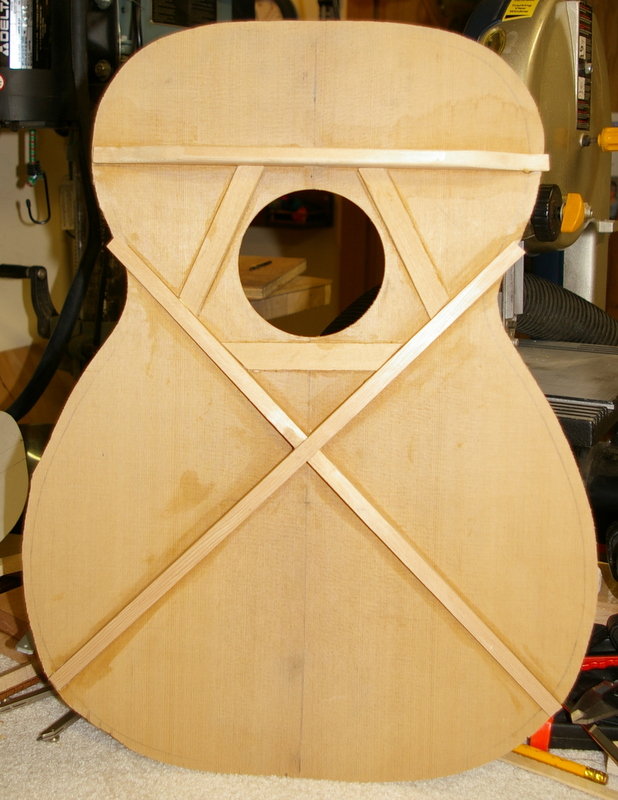
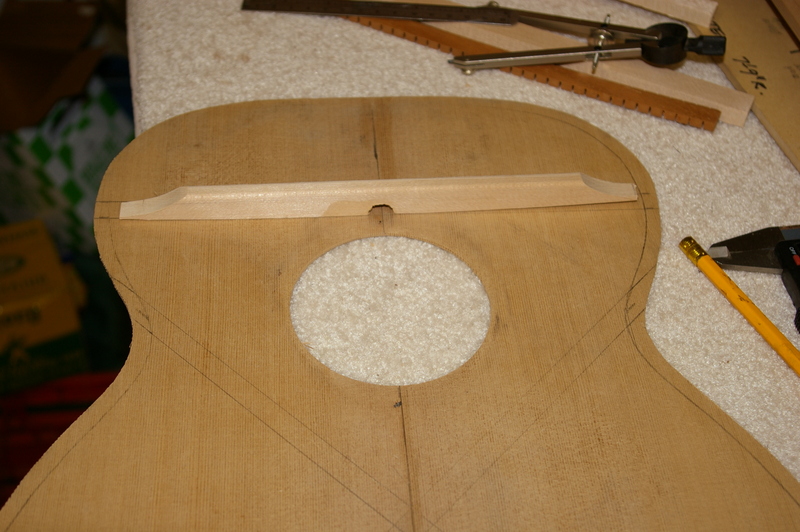
top with bracing complete

top with bracing complete

My top bracing for this guitar is arched. There are only 3 major braces. The transverse one at the top is for strength mainly, so it is 19mm high. It has a hole in it for accessing the truss rod adjustment. The main X-brace is smaller, and tapered down to zero at the ends. This is where the sound is produced, so it has to be a balance between strength and flexibility. The three pieces around the sound hole are off cuts from the top, thin pieces to strengthen the area of the hole against possible breaks.

I also did some spectrum analysis  of the plates, using the computer. I hold up a plate to a microphone and give it a dozen taps with a felt covered hammer, similar to a piano hammer. I use a free program called Audacity for this. It has a function to analyze the spectrum of a recording. This shows me a graph (logarithmic) which gives an idea of the peaks and relative strengths of various frequencies. There’s a lot of unsubstantiated hokum around tap tuning, but I do this more out of curiousity than anything. Then I export the results to a text file, import this to Excel, and then generate a graph. This will show me the dynamic range. I then plot a trendline which gives a better overview of the response. But after all is said and done I shave the braces until it sounds good, and is still stiff enough. Better to stop before it’s too late. The top has to support the strings or it’s all over, structurally speaking.

spectrum analysis of the top

spectrum analysis of the top

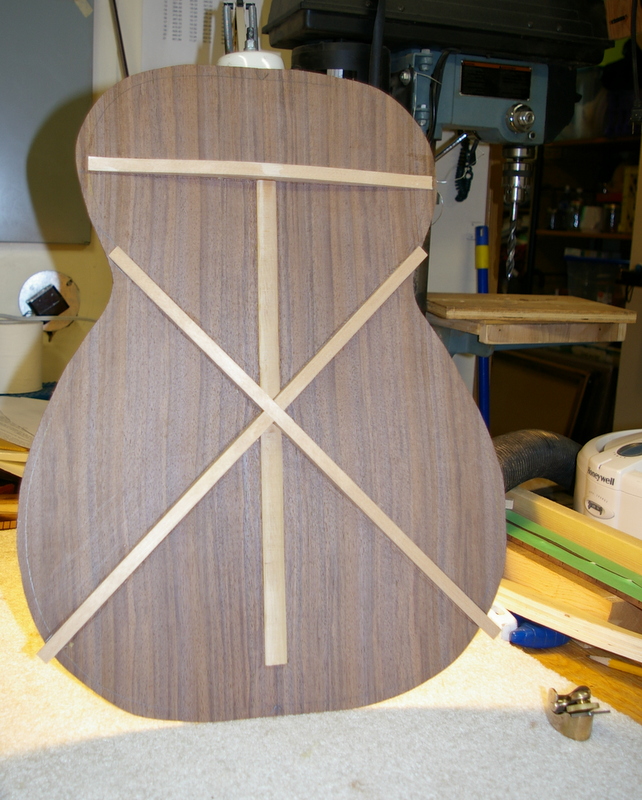
back bracing complete

back bracing complete

I’ve also done the back. I shaved the braces to drop the fundamental frequency as low as I dared. The back however, unlike the top, doesn’t carry any downward pressure, so the braces can be lighter. Hardwoods are always lower in tone than softwoods, simply due to their density. This back plate is several whole tones lower than the top plate. The bracing design is identical to the top, same arching, same locations. The back braces do not taper to zero however. They are let into the linings at the perimeter. The centre strip is merely a precaution to reinforce the centre joint. Many guitars do not have this, but it doesn’t affect the sound so I put it in.

side bending setup - aluminum pipe with bbq lighter inside

side bending setup – aluminum pipe with bbq lighter inside

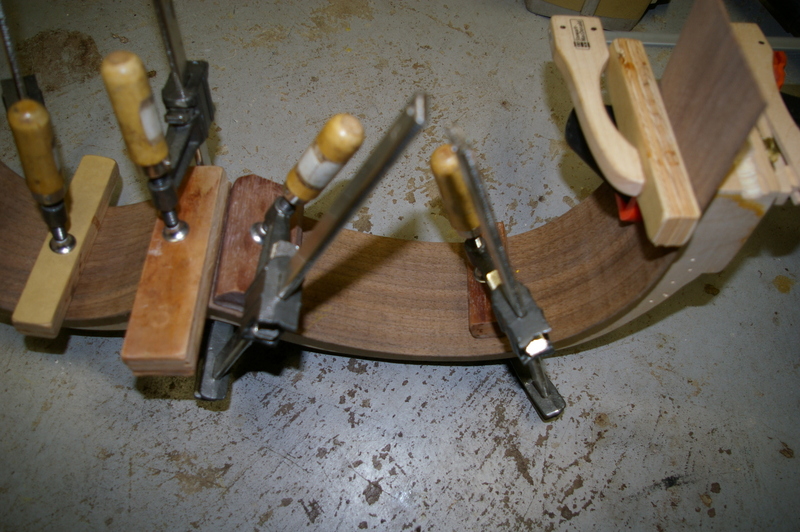
Once the plates were done I bent the sides (ribs). I made a template from thin MDF, and marked off 25mm hash marks on it. Then I marked the sides with a yellow pencil at 25mm spacings, and labelled them. This helps immensely with bending. I have the bending pipe clamped in the vise and an old BBQ lighter which has been squeezed when hot, shoved inside the pipe. This is controlled by a light dimmer. Full power would be much too hot. I run it around 50-60%. The bending is not hard once you get a feel for the wood. It takes patience, however. This guitar is made of Black Walnut, which bends very well. Some wood is horrible to bend, like Paduak. Once each side is bent to the profile of the template within 2-3mm tolerance, it gets clamped into one half of the mold. The mold splits in two for this purpose. The sides are bent wet, and the steam generated by contact with the pipe softens the wood so it bends. I use a spray bottle to keep the wood wet. It dries out very fast once in contact with the pipe.

side piece clamped in mold until it dries

side piece clamped in mold until it dries

2 Comments

Filed under Guitars

Guitar #29/5

plate joining jig

plate joining jig

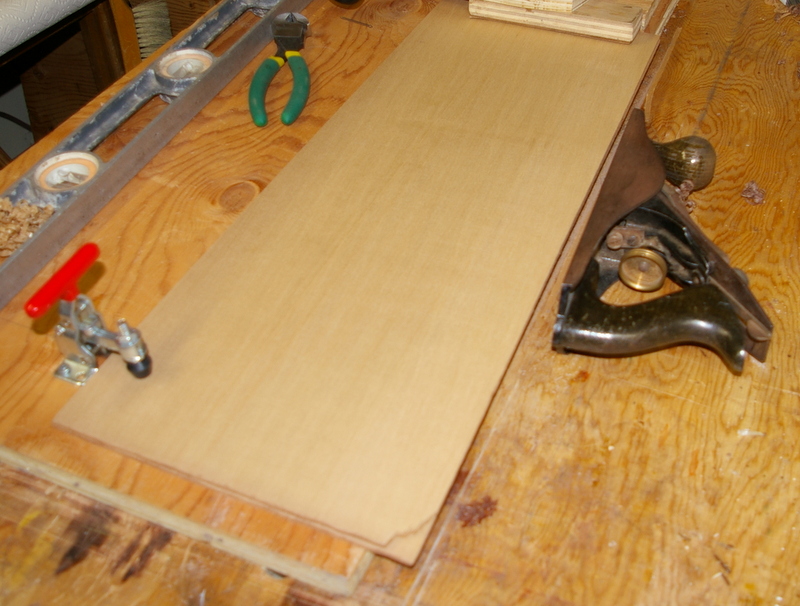
The post office delivered the wood on Sunday. Only at Christmas time. So I got to work and joined the top and back plates. For this I use a jig known as a shooting board. I find it hit and miss, but eventually with enough planing and sanding with a long straight edge the two pieces matched. To test if they do in fact match, you only have to hold them up to a bright light, edges together. Any defects will shine through.

After I joined the plates I tackled some other sundry tasks. One was to put the neck dots in the fingerboard. This is done by drilling holes and stuffing in round plastic rod. The plastic is immersed in acetone for 30 seconds, during which time it begins to dissolve on the outside. Then you push it into the holed and snip it off. Later when it hardens up again it will be sanded down flush. After this I marked and trimmed the fingerboard to a rough taper, with an extra millimeter on each edge.

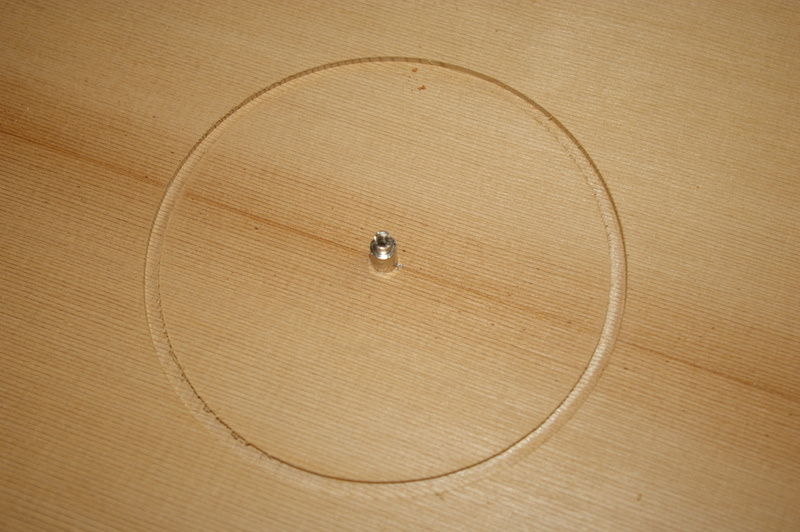
Back to the sound board: next step is cutting the channel for the rosette. This rosette is simple, just four 3ply black and white laminated strips sandwiched together. I have a jig for this, comprised of my Dremel tool, a special base plate and a plywood base with a steel post in it. The channel diameter is set and then cut with a down-cutting spiral bit. I had to make two cuts to get the correct width for the laminated purfling. Then I tapped the 4 plies into the channel which was pre-filled with thick super glue. The purfling was pre-fit and cut dry beforehand of course. A while later when this was all dry I put the top back on the plywood base and cut out the sound hole. First I cut halfway through on one side, then flipped the piece and cut through the other side.

I also sawed up some brace stock from a nice piece of kd hemlock trim I bought for this purpose. It was already 10mm thick, so I simply ran it through the band saw to get the height I needed. I rough sawed them to 17mm. Next step was to draft the curve of the top onto the braces. This design calls for only three braces; the upper face brace which is at the end of the fingerboard, and the main X-brace. I have a curved template for this. I then use the bench sander to grind off the bulk of the wood, then switch to the disc for finishing. With a little practice you can get a perfectly smooth curve this way. All three braces use the same curve, which provides the dome in the top. This dome in turn provides the strength to carry the force of the strings  on the bridge.

gluing the top plates, with weights

gluing the top plates, with weights

top plate with circle cutting jig set to go

top plate with circle cutting jig set to go

the rosette channel

the rosette channel

purfling strips glued into the channel

purfling strips glued into the channel

rosette after sanding

rosette after sanding

underside of the sound board, marked for braces

underside of the sound board, marked for braces

Leave a comment

Filed under Guitars

Guitar #29/4

Today's efforts: neck & fingerboard

Today’s efforts: neck & fingerboard

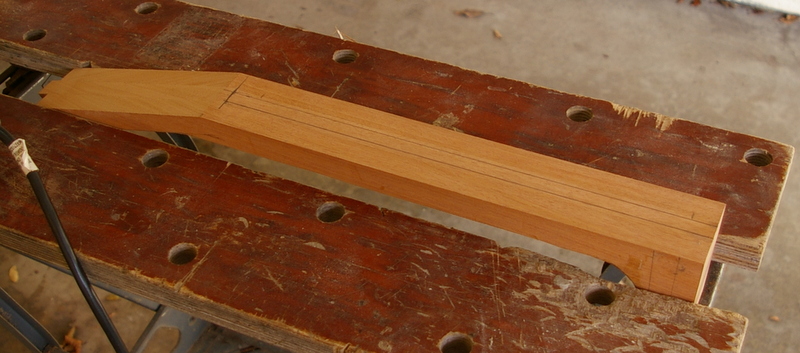
To make a guitar you need a few essential tools. The band saw is one. Another is a combination bench sander; the kind with a belt and a disc. This is the quickest and most reliable way to make flat surfaces. To prep the neck today I first band sawed the angle of the heel. On this guitar it is 2.5 degrees, because the top has an arch. Now that the band saw works reasonably well I made the cut fairly precisely and then finished it up by dressing it dead flat on the stationary disc sander. Next I flattened the upper face, to which the fingerboard is glued. Although the three pieces of the neck had flat surfaces to begin with, after gluing they’re never perfect, so the face has to be made dead flat. For this I used the stationery belt sander. After the face was done I marked the break where the fingerboard ends and the headstock begins. More sanding to get right to this line and the neck was ready for the truss rod.

neck clamped in the workmate table

neck clamped in the workmate table

I decided to go with a hidden truss rod. It will have to be accessed from inside the box, but it looks cleaner. To cut the channel for the truss rod I use my 1 HP router. This is very powerful, but it works perfectly if you set it up right and push in the right direction. Once I set up the jig and secured the neck in my Workmate (another essential) I was ready to cut. This took about 30 seconds. Then it was time to do the worst of all jobs: cut the dovetail. I decided to tackle this right away while I had the router out. For this I have a jig with templates for cutting the male and female dovetails. Although the body is not yet made I can still do the neck joint. I use a special tapered bit and a guide collar that fits the router base. The dovetail is 70mm long and 15mm deep.

Dovetail jig

Dovetail jig

Router and cut slot - the guide is on the far side. Router cuts from right to left, not the other way!

Router and cut slot – the guide is on the far side. Router cuts from right to left, not the other way!

The neck, the hardest parts are done!

The neck, the hardest parts are done!

Next step, glue the truss rod into the slot with 5 minute epoxy. I like fast epoxy for this, because it only takes two or three minutes to apply the 1/4 ounce of glue required, and it sets up fast. Sometimes regular epoxy needs 24 hours to get super hard, and by that time I’m ready to glue the fingerboard. I mixed up a small amount of epoxy, about one table spoon, and with a tiny art spatula I applied epoxy to the sides of the groove and the sides of the truss rod. It dropped right into place, but the epoxy takes up all the extra space, so it then has to be clamped to fit. Waxed paper (essential), popsicle sticks and several screw clamps do the trick here.

Truss rod with epoxy, wax paper and popsicle stick used as a caul for the clamps

Truss rod with epoxy, wax paper and popsicle stick used as a caul for the clamps

While this was setting I got out my little table saw (essential) and cut the neck and tail blocks from the left over end of the neck blank. Then I switched to the fret saw blade, a special blade that cuts a very narrow slot. I made a sled jig that runs on the saw table for fret cutting. I use a fret scale, which is invaluable for this job. The edge of the fingerboard was planed flat first, then I taped the appropriate scale to the blank fingerboard. A few test cuts set the slot depth at 3.5mm. Then I carefully cut the 20 frets and the zero fret. Once they were done I marked the ends and raised the blade to make the end cuts.

Fret cutting jig, with engraved fret scale

Fret cutting jig, with engraved fret scale

Leave a comment

Filed under Guitars

Guitar #29/3

1-IMGP9279-001

miscellaneous parts – kerfed liners, truss rod, fingerboard, nut blank, fret wire, wood binding, cut our neck blanks

4-IMGP9282

neck blanks glued and clamped

I ordered some parts yesterday from Stewart MacDonald in Ohio. They just arrived this afternoon. Ohio to Memphis to Vancouver to Victoria in 24 hours. Before they arrived I worked on the neck. I bought a nice piece of mahogany at a local shop, but it was warped, so I had to go back and get a straight piece. Earlier I spent several hours adjusting my band saw, which was working poorly. Now it works slightly less poorly. It’s a cheap thing and I’ve had it for years, so I suppose I shouldn’t complain. But I will. I discovered that the table was not flat. I don’t think it warped recently, it’s made of cast aluminum. All this time I had a warped table and didn’t realize. So I spent some time grinding the top of it on my bench sander. Then I adjusted the blade after watching a good video on Utube about this.

So once it was working again I set to cutting the neck blanks. I already had a cardboard template for a 25″ scale, so I used this to trace the outline onto the mahogany blank. The blank was 3.5″ x 3/4″ and 5 feet long. I cut out four blanks, since you can get 2 per 2 foot length. They nest together. The extra length will be used for the neck and tail blocks inside the body. The saw cut better after the adjustment, but still a bit wonky.  Next I took the 3 best pieces and set them on the bench with the long flat edges down. The finger board will be glued to this face. Then I liberally slopped on the Titebond type 3 glue, which is waterproof. If you want to be able to disassemble any wood parts, you have to use regular PVA carpenters glue, but for the neck pieces I used glue that cannot be heated or steamed apart. This is for one main reason. If ever the neck has to be removed in future, it gets steamed off at the joint with the body. I’ve seen the seams of the dovetail end of the neck separate a bit after this steaming, so I’m being careful here to ensure that doesn’t happen one day.

Once the glue dries I will  shape the neck some more, and install the truss rod.
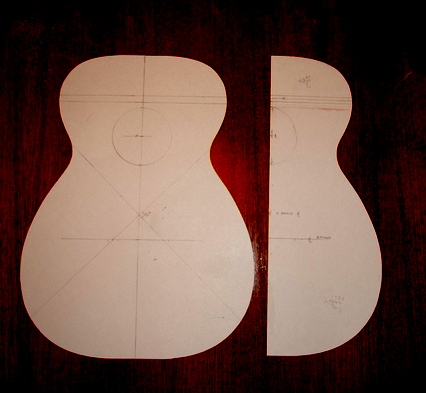
neck pattern

neck pattern

3-IMGP9281

the neck glued up & clamped


1 Comment

Filed under Guitars

Guitar #29/2

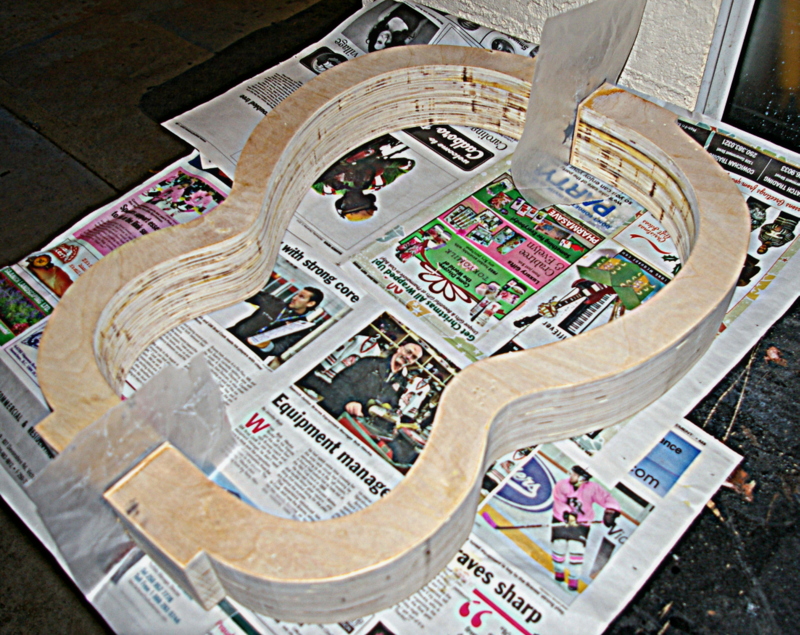
Guitar mold - day 3

Guitar mold – day 3

The order for my wood is being processed. I buy the wood from a dealer here in BC, and they sand it to my specs. I used to have to sand it myself, which required having a wood shop do it, or a friend. Now I get it done for me, which saves a huge amount of time. They only charged me half an hour labour.
I spent a long time sawing the outer edges of the mold today. My tiny band saw is not made to cut through 3″ thick plywood. But it did, painfully slowly. I sanded it all up and put the halves together. They didn’t mate perfectly, of course, so I sanded the mating surfaces. Then they were a bit short so I added a thin piece of spruce to each end to make up the loss. They were still not mating perfectly, so this time I did what I should have done first – I got out the JB Weld.
I separated the halves with a little waxed paper, and applied a gob of epoxy to the mating surface ends of one half. Then I gently pushed them together, with the whole thing flat on a table. I bought draw catches to clamp the halves together and I will put dowels in to ensure they register properly. Document (35) (2)

Leave a comment

Filed under Guitars

Guitar #29/1

Martin O15

I’m building a guitar for a friend. It will be based on a Martin O-15. It’s small, about the smallest full size guitar Martin ever made, but it has a great sound. The 15 series were all mahogany, and had minimal trim.
The one I’m going to build will be made of walnut, with a cedar top. It will not be a flat top, but will have an arch. This will require a tailpiece and a floating bridge. Martin made some like this around 1932, the R model, but they were short lived.
So far I’ve traced the body shape of an O-15 I borrowed, and made a paper half template. From that I traced a full size body outline on Bristol board. Next I drew in where my braces and the sound hole will go. Then I made a body mold from 8 pieces of 9x22x¾” plywood. This involves band saw cutting, drum sanding, and finally routing the seven rough sawn shapes using the master as a router template.

Body plan and half template of bristol board

Body plan and half template of bristol board

Body mold glue up

Body mold glue up

Leave a comment

Filed under Guitars, Uncategorized

Look Up, it’s Skywriter!

1-dec 7001

1-IMGP2317

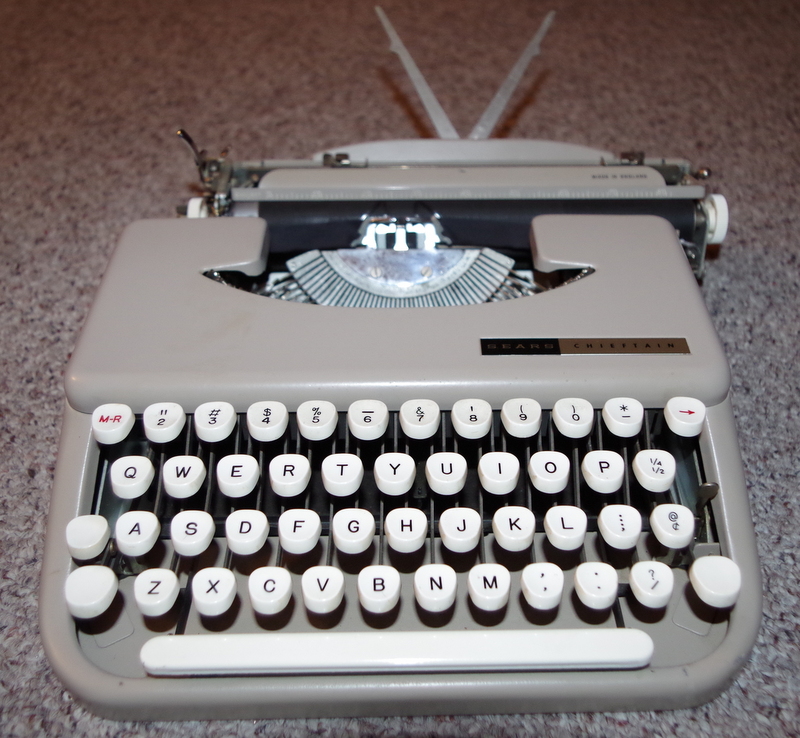
Sears Chieftain – Smith Corona Skywriter

1-dec 7002

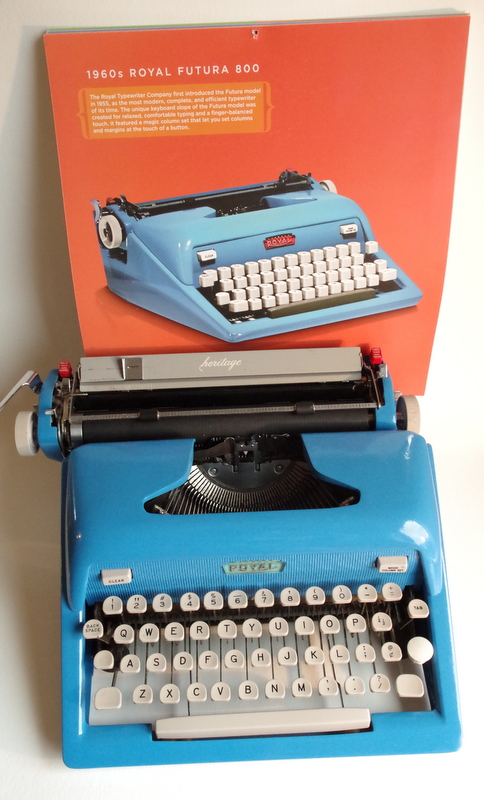
Royal Futura with new paint job

Royal Futura with new paint job

Does Sears still fix 50 year old typewriters?

Does Sears still fix 50 year old typewriters?

2 Comments

Filed under NaNoWriMo, Thrift shop finds, Typewriters

On the Road

1-sk003

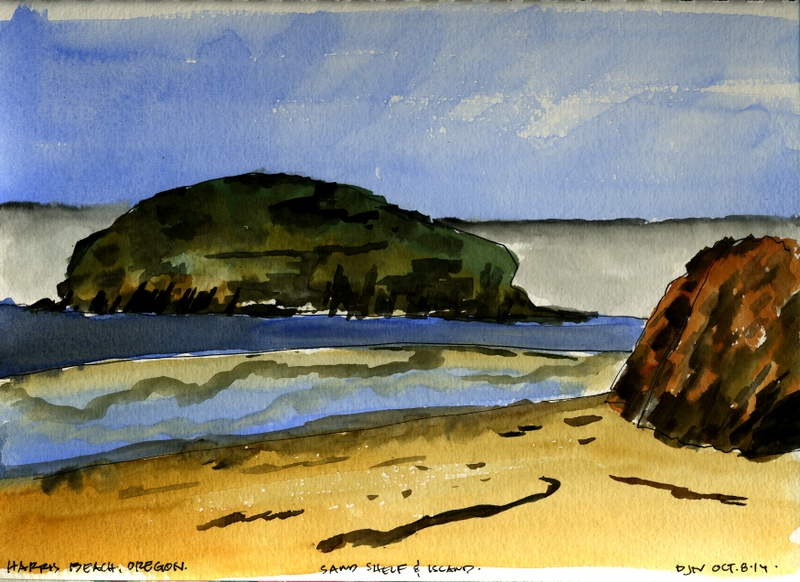
Harris Beach, Oregon coast

Summer behind us here, with two weeks vacation to spend we set off on Highway 101, down the Pacific Coast, bound for California. Like all trips, this one was a perfect opportunity to do some sketching and scour the thrift and antique shops for cool stuff (typewriters and old cameras). 101 is a marvelous road, full of stupefying vistas, interesting towns and endless campgrounds.

After 2 weeks of browsing, it was on the last day of the trip that I discovered two typewriters that I could afford. The poem was typed on the one in the picture. The typewriter came with the previous owner’s name on it. A Google search revealed that she died over 10 years ago, but her husband only died last year. So I surmise that the typewriter was disposed of by estate sale, hence ending up in an antique mall.

My first trip down 101 was about 25 years ago, and I thought it wasn’t very interesting. At the time I was fresh from the east coast and had been hoping to see a lot of quaint east coast villages. Now, many trips along the route behind me, I see it differently – an amazingly interesting and varied route. I can hardly imagine that there is another single highway of its length that offers so many beautiful landscapes and scenes as this one does. However, I have heard tell that US Highway 20, which happens to start at the intersection with 101 in Newport, Oregon, is a likely competitor. One day…1-sk004

1-sk002

Manzanita trees, Napa

1-sk001

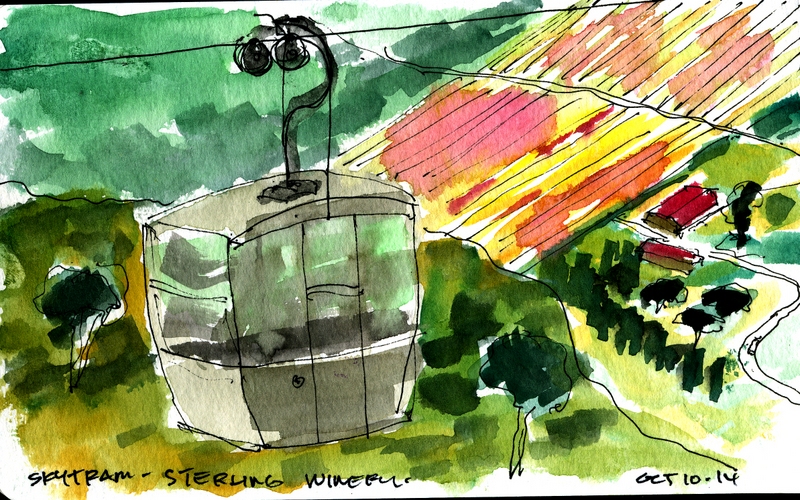
Skytram at Sterling Wines

1-1-IMG_0540

Typewriter from Astoria, Oregon


2 Comments

Filed under Painting, Poetry, Thrift shop finds, Travel, Typewriters, Uncategorized, VW Vans

The Huns are Back

We could use a laugh around here today… this is a storyline I’ve been using for my kids bedtime stories going on 30 years. This one is new, I wrote it for our annual camping trip. This is the first time I’ve illustrated a story.1-IMGP2158
PRINCE RHINESTONE AND THE HUN

By Donald J. Nathan
©2014
When Prince Rhinestone returned home after some years of fighting Huns, he had grown several inches, and needed new armour.
He paid a visit to his armourer, Sir Breakwind, to be fitted for a new suit, along with a matching sword. When he walked into the workshop, however, he was surprised to find that Sir Breakwind had gone out of business, and found himself smack in the middle of an auction sale.
“I say,” said Prince Rhinestone to no one in particular, “I say, what is going on? Where is Sir Breakwind and why isn’t he here? I want a new suit, and a matching sword!”
There were chuckles from the crowd and Prince Rhinestone looked around vexedly.
“Sold for thirty seven shillings to the man in the green pants,” said the auctioneer, slamming his gavel with a bang.
A short man came waddling up from the back of the room to the clerk and pulled out some coins from his purse. He dropped them on the desk, picked up a box of chain mail and turned to leave. Prince Rhinestone followed him out the door and hurried to catch up.
“Excuse me my good sir,” he said, tapping the man on the shoulder, “would you be so kind as to tell me what exactly is going on here?”
The man looked up at the Prince.
“Sir Breakwind, he’s gone out of business, your Highness. It’s a shame I say, but what can be done I asks you, Sir? It’s that new cheap imported armor what done it. Old Breakwind, he couldn’t compete with it, no Sir. Shame I say, damned shame.”
“Thank you my good man,” said Rhinestone, bowing ever so slightly, “and where does one find this new armor I pray?”
The man nodded his head to the side – “down that street, and round the corner in Highcastle, that new shopping street.”
“Never heard of such a thing,” said Rhinestone, walking away.
On his way down the street he noticed that many old shops he’d once frequented were gone, boarded up, with For Rent signs nailed to the doors. In all his life he’d never seen such a thing, and he was sorely puzzled.
When Rhinestone turned the corner onto Highcastle Lane his puzzlement turned to surprise to see a great crowd milling around. There were great heaping piles of goods for sale, and posters with words like “New and Improved”, or “Price Reduction”.
But there were no shopkeepers to be seen, only clerks sitting at desks taking money from people lined up with armfuls of goods. Noticing a large sign hanging from the ceiling with the word “WEAPONRY”, the prince worked his way through the crowds. There a young boy was arranging maces in a neat pile.
“Where is the armourer?” asked the prince.
The boy looked at him with a vacant stare.
“The what?” he replied.
“Never mind,” said Rhinestone, picking up a mace and swinging it around. “How much does this cost?”
“One shilling,” said the boy, “but if you buy one you can get another for half price.”
Rhinestone frowned. “Why would I need two?”
“I dunno,” said the boy, “everyone buys two.”
Rhinestone pulled out a shilling and handed it to the boy.
“I’ll just take one, thank you.”
“You have to pay the clerk,” said the boy, pointing to the lineup.
Rhinestone pulled out another penny from his purse and gave it to the boy.
“Here, you go pay for me,” he said, and turned to go.
“You can’t do that here,” said the boy, handing back the money, “you have to pay the clerk, that’s how it’s done.”
Rhinestone took his money and walked to the back of the line that said “EXPRESS – MAXIMUM FIFTY ITEMS”. An hour later he paid for his new mace and walked out of the store onto the street.
As he turned the corner an armed and dangerous looking Hun appeared right in front of him. He was huge, with great big blue eyes and a hooked nose.
“Take that,” said Prince Rhinestone, smashing the Hun with his new mace.
The mace gave a great clang, bounced off the Hun’s head and snapped in half. The Hun glared at Rhinestone for a moment and began to laugh.
“I bet you that was a cheap imported mace,” he roared.
Rhinestone looked at the broken handle of the mace in his hand, and nodded.
“Yes it was,” he said, disgustedly, “buy one and get a second one for half price.”
“You should have bought a second one, you fool,” said the Hun taking a swipe at Rhinestone with his sword.
Expecting such a response Prince Rhinestone ducked, but the Hun’s sword cut the head off an innocent bystander who had been hurrying by. It was the man who’d bought the box of chain mail. Rhinestone picked up the chain mail from the box and held it up to show the Hun.
“If he’d only been wearing this it might have saved him,” said Rhinestone.
“Serves him right,” said the Hun, “the world is going for shite with all this cheap imported crap.”
“That’s a good sharp sword,” said Rhinestone, “where did you get it?”
“Japanese,” said the Hun. “Took it from a dead Samurai. I’ve beheaded hundreds with this and it’s still sharp.”
“Thanks for the tip,” said Prince Rhinestone, “but I think I’ll stick to my sword. It’s Italian.”
“Hmmph,” the Hun grunted, “didn’t help those Romans, but too bad about that fellow. I don’t usually do that.”
“Hey, no hard feelings,” said Rhinestone. “Let’s go have a beer, my treat – what do you like?”
“If it’s cold I’ll drink it,” said the Hun. “Can you get a good Hefeweizen in this town?

THE END

1 Comment

Filed under Books and Short Stories, Painting, Uncategorized

Paris in the Backyard

IMGP9229Paris001

P.S. this really was from the backyard:

anyone for a game of cribbage?

anyone for a game of cribbage?

2 Comments

Filed under Photography, Travel