Eaton’s 703 Portable Phonograph

Eaton’s 703 portable phonograph

Last year I missed out on a wonderful old German portable phonograph I saw in a thrift shop but didn’t buy. See that post here.

When I saw this old suitcase phonograph the other day I grabbed it. It worked poorly at first but I was able to remove the stuck platter and clean off the old grease, lubricate it and get it going. It has a BSR automatic turntable which was very common, and there are many videos about fixing them. The amplifier, a mono unit with one vacuum tube, puts out a decent sound through a very small speaker. These units generally had ceramic phono cartridges which although not hi-fi were good enough for their purpose. Here is a video demonstration using one of my old LP’s with the Beatles classic No Reply, from Beatles 65, featuring evocative vocals by John Lennon. The sound, although poor by modern standards, is still thrilling and I even enjoyed the 60 cycle hum!

I have no idea who manufactured this unit, but it was sold by Eaton’s, and made in Canada. It could be an Electrohome, or perhaps RCA Victor.

Anyone have 16 rpm records?

The wiring is stereo but only two wires are connected to the amplifier, and the cartridge is mono too. It has a dual needle stylus type ST8, which is still available, and plays 78’s too.

1 Comment

Filed under LP's, Phonographs, Technology, Thrift shop finds

Plein Air Day

Sometimes we just stop doing things for no apparent reason. For the past year I didn’t do any painting. I can’t figure out why. However, today was the annual Plein Air Challenge here, sponsored by a local art store. I’ve done it the past few years and decided I’d take part again. Last night I put my kit together and this morning I went out and did a painting. I was rewarded with a beautiful day, and a very pleasant time spent closely observing a boat and the harbour. One hundred and thirty people came out, and it was great to see them all over downtown with sketchbooks and easels. There were no prizes for artwork this year, only door prizes selected at random. I didn’t win any but I felt like I’d won a lovely day enjoying myself. Maybe I’ll be back painting and sketching again before I know it.

Leave a comment

Filed under Painting

Fastenephemera

Bostich B5

Yesterday I printed a 10 page manual for my guitar amp, downloaded of course since I didn’t have the original. I went to staple it together with my trusty VICTOR stapler, but that failed miserably. Later on I was passing the office junk aisle in a thrift shop (where else) and spotted this old stapler for $4. It looked rugged, my foremost criterion for a stapler, so I purchased it in the hope it would blasted through 10 pages like “butta”. It didn’t disappoint! I began to wonder how old it was. I was shocked to discover, through circuitous web searching, that the basic design dates from 1936!

One other reason to like this stapler is how well it matches old Smith Coronas, dull greyish crinkle paint and all.

Smith Corona Silent Super 1955 – script type

Here’s a US Patent drawing for the same stapler from 1939, filed 1937. This fellow Maynard filed a whole lot of patents, many for staplers, but lots of other stuff. It wouldn’t surprise me if he even designed a typewriter…

Here’s a side view of mine. Dig the background – a vintage George Shearing LP cover. The record itself was awful, but we generally like most of Shearing’s stuff.

The other old item I acquired yesterday was a pink depression glass plate, $2. Someone out there who knows more than I do says this is Federal Windsor button & cane design. Beats me, I like the colour!

pink depression glass plate

Last night I served myself a Peek Frean tea biscuit on this plate, with a beer. Both were delicious!

1 Comment

Filed under LP's, Staplers, Technology, Thrift shop finds, Typewriters

Typewritephemera

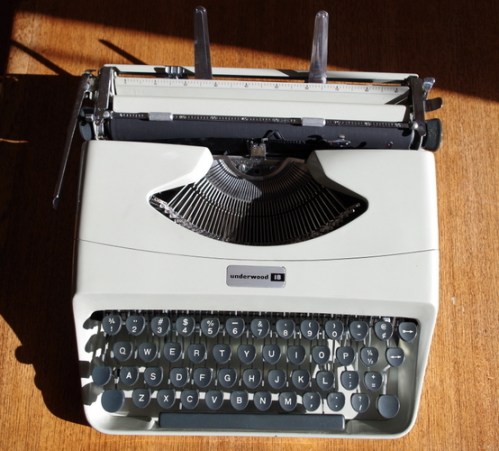
This morning I came across an interesting ultra-portable typewriter: a Majestic 700. It is in fact a Smith Corona Corsair/Skywriter/etc, with plastic case and lid; probably the lightest of any machine I’ve seen. I had no camera but the picture above is the same model. This one was made in Canada. Curious about the Majestic brand I searched and discovered most were made by Brother. I also found an interesting old advert from Eaton’s of Canada. Eaton’s carried a good variety of everything made on earth at one time. The copy states that the Majestic case was made of “Cycolac”, a new material then. Among the small portables you could buy a Lettera 22, Hermes Rocket, Underwood 18, or Majestic 700, each for $80. The Majestic 400 however, presumably a Brother JP1, was a mere $55. All machines were available in English or French, Pica or Elite; no mention of script!

1 Comment

Filed under Thrift shop finds, Typewriters, Vintage advertising

Thrift Bonanza – c.195x

viewfinder 1955 Asahiflex

Asahiflex IIA – first SLR from Japan

viewfinder 1953 Rolleicord

Rolleicord IV

Smith Corona Silent Super 1955 – script type

the secret 1 key

P.S. here is an OCR attempted scan of the typed page 1 above:

5 Comments

Filed under Cameras, Technology, Thrift shop finds, Typefaces, Typewriters

Baby Hummingbirds Feeding

March 24, 2017

1.30 pm – back at the nest waiting for the mother hummingbird. Got the 500mm lens on the camera now. Checked my focus and exposure ten times. Been here 5 minutes. Saw hummingbirds flying here and there but not near the nest. When I arrived I saw a squirrel heading down the trunk of the tree. Did it find the nest? I suppose not, as the nest is intact. Much chirping in the area.

Waiting… waiting… saw two Hairy Woodpeckers and a Red Tailed Hawk. People pass by on the trail, but I just sit here. No one sees the nest, and I don’t point my camera at it.

1.50 pm – the mother has to come soon. How long can she stay away feeding herself? Hold on, she’s over there on a branch. I blink and she’s gone again. Where did she go? She’s on the nest! I missed her fly 15 feet in a blink. Camera up, start clicking.

mother arrives

feed baby #1

baby #1 fed, check around

time for #2 next

feeding baby #2

done and gone in a second


2 Comments

Filed under Birds, Photography, Wildlife

Equinoctial Photographic Magazine

Today on the trail I met two chaps observing something through a huge 3′ telescopic lens. I stopped to chat, curious about what they were looking at. It was a hummingbird nest.

hummingbird nest

I looked but didn’t see it at first, thinking it must have been 100 feet away. But it wasn’t – it was close at hand right on top of a bare branch, exposed to the weather. The mother returned and flitted around for a minute or so before a lighting on the branch, whereupon she began feeding the babies. I could see wide open tiny yellowish beaks from where I stood, but there was no sound. The big camera began clicking away and I didn’t want to horn in while watching, so I waited until many pictures had been taken then raised my own camera and focused on the mother. She stopped feeding, looked up and flew away. I did get one picture of her, however.

hummingbird and nest

Not far from there I saw a squirrel lying unusually still.

squirrel at rest

The field nearby is full of daffodils.

daffodils

Going through the pictures from the last month I was struck by how much the weather has changed. In February we had plenty of snow.

Today when the sun came out it seemed like winter was long gone. Three days ago I saw a turtle, sunning.

People here are saying spring is a month later than normal.

red tailed hawk

flicker ground feeding

one of the “wild” cats that hang out in the park

a mouse, after the owl ate it

crocuses

hooded merganser

blue bug on the window

6 Comments

Filed under Birds, Photography, Wildlife

Best of ’68

caravelle-transistorized-watch-ad-1968

In 1968 I was with my Dad wandering around on our summer holiday in Lake Placid. I hated the place. There was nothing to do but swim, walk around town, or take a boat out, all of them by myself. There were no kids my age except twits at figure skating camp, and they were a closed group. Beside, I was a hockey player and thought boys that figure skated were weird. Perhaps my Dad took pity on me, because for no reason we went into the jewellery shop and he bought me a Bulova Accutron. At the time it was the most accurate watch, and the one used on Apollo missions! I still have that watch, and it works fine, 49 years later. However, it takes a mercury battery, and they are obsolete. If you want a battery for an Accutron now you have to pay $12 plus shipping. As wonderful as the watch is, I’m not so keen that I’d spend $15 or more to run a watch for a year, after which it would need another battery, etc, etc. I have too many other watches to wear. Recently I picked up another one for $4 at a thrift shop:

Caravelle 1968 "transistorized"

Caravelle 1968 “transistorized”

Yep, the same watch as in the advert up top. Made in 1968 or thereabouts, this was the cheaper baby sister to the Accutron, and it has a Japanese made movement made by Citizen. This is a hybrid between a regular windup watch and an all electric one, having a complete movement minus power spring. Instead of a spring it has a tiny motor. The battery is a standard 1.5 volt affair, still available today. I opened the watch and removed the dead battery which may well have been the original one, since it had the name Caravelle engraved right on it! For $2 I got a pack of 5 alkaline cells, and installed one in the watch. At first it didn’t run, but that was due to the bottom of the cell shorting out against the innards. I put tape on the base of the battery and cut a small slot for the contact, then replaced it in the watch. It started up and has been keeping perfect time ever since. It ticks like a windup watch, too. The question is, which watch proved to be the better one in the long run?

Here’s the Accutron. It said waterproof, and it was – I swam with it for years. I wish I could get a cheap battery for it.

img_0693

Accutron 214, 1968

no stem, it's on the back

no stem, it’s on the back!

Which brings me to another recent piece of 1968 technology that lives on and on and on…

1968 Olympia SF

1968 Olympia SF

I took the shell off to clean and adjust this one. The automatic ribbon reversal mechanism on the right side was jamming so the ribbon would get taut at the end and not reverse. After some examination I saw the problem, and fixed it by filing off the point on the plate  attached to the ribbon flipper, so it no longer hit the arm it was supposed to push over and thereby flip ribbon direction. Aside from that I blew out the dust and gave it a spray of silicone lube. It’s from Britain, and has many fractions but no exclamation mark. How British – no exclamations… only stiff upper lips, hmmm? I get great results with Olympia portables (the baby ones) by using old mylar ribbons. I drop the spool onto one side and thread the ribbon onto the opposite spool without going through the flipper gates. Half the mylar will fill up one regular empty spool, after which it can be turned over and reused on the bottom section. I’ve tried mylar on some other typewriters and it doesn’t work well on every machine, but works perfectly on these.

mylar ribbon

mylar ribbon

Leave a comment

Filed under Technology, Thrift shop finds, Typewriters, Watches

Fiacre’s Fork

4-dscn3589

We visited the garden last week to look again at the plot and think about what would have to be done to get it ready for planting. Margie said we needed a pitchfork. Then we got to talking about the patron saint of gardeners, St. Fiacre. He’s also the patron saint of taxi drivers from an odd twist of fate having to do with where taxis used to come from in Paris, near the Church of St. Fiacre. Fiacre was born in Ireland in the 9th century, and his brother and he both became saints. So we began joking about St. Fiacre, as if he might be listening.

Jokingly about divine intervention we hit a few thrifts but didn’t see one pitchfork, although I did see an alpine ice axe. As we left I noticed a man buying it. No serious mountaineer would trust his life to a used ice axe; that I am certain of, as I am also certain the man was therefore no serious mountaineer. That made me wonder what he was going to do with it. Maybe he had a garden and planned to use the cutting end to hoe at the earth? Was he too seeking a pitchfork?

We checked out two stores where they sold new pitchforks. The first was $25, but M thought it was very heavy. I held it in my hands and had a look at it. On the fork part was stamped the word ‘Austria’. The handle was oak, and very thick. It was heavy duty, for sure. Next door a garden shop had one for $60. The handle was oak, but stained. I looked at the fork and there was the word ‘Austria’ stamped into the steel. This is the same tool with some more varnish, I said, hanging it back on the wall. They’re both too heavy, Margie said. I want one that’s lighter, the sort I remember from long ago. We came home with a bag of seed potatoes and a garden gnome. Later, Margie went to another garden supplier that had another heavy pitchfork for $100.

She went off to sing with friends and I went out to do errands. I decided to go down to the big thrift shop that’s always open. I hadn’t been there in a week due to the snow we had here, so it was time for a look see anyhow. I walked down to the back and saw a large cardboard barrel in which there were some shovels. Then I saw a cultivator. Thinking that might do for turning up dirt I lifted it out of the barrel, and saw that it was $5. Not bad, I had one useful gardening tool. There were several shovels too, nice ones, but we didn’t need any, so I resisted purchasing a cheap shovel.

Then I had one last look, and saw a red D handle of something that I assumed was probably an edger. I grabbed that and lifted it up when to my delight I recognized the prongs of a pitchfork, just like the one that stood in the corner of my parents’ garage 50 years ago. True Temper was stamped on the shaft, which was oak, but much thinner than those we’d already seen and rejected. The fork itself was lighter, too, with tines chamfered to reduce weight and make it easier to plunge into soil. The whole thing was half the weight of the modern ones we’d seen. It was $6. I decided to look where the others had been stamped, and there I saw the word ‘Eire’. Ireland, birthplace of St. Fiacre. In honour of our good fortune we named the new gnome Fiacre.

Bienstock, Einstein & Fiacre

Bienstock, Einstein & Fiacre

By the way, it’s not really a pitchfork, it’s a garden fork. The devil carries a pitchfork. It’s probably stamped ‘Austria’.

1-dscn3596

Irish potato fork

Leave a comment

Filed under Books and Short Stories, Gardening, Thrift shop finds

www.Wine, Wallabies & Wombats

Quick quiz: what comes from Australia? Not what lives there, what leaves there! Can’t think of anything? Nor can I, except wine and souvenir boomerangs. If one were to look on the bottom of most every manufactured item in our house, I wager none of them would have the word Australia. So we were truly amazed when on Saturday, drifting through the thrift shop next to the Mediterranean grocery store (nothing from Australia in there to be sure), my wife picked up an unfamiliar looking tin cylinder with lids top and bottom. Fastened around the tin with a rubber band was a label bearing a recipe for nut loaf. The lids were embossed with the trade name “Willow” and the word Australia, as well as “NUT LOAF” and dimensions in m/m, Australian for millimetres.

Willow Nut Loaf 170 m/m x 80 m/m

Willow Nut Loaf 170 m/m x 80 m/m

A web search turned up the key to the mystery. Willow nut loaf tins were an Australian phenomenon, made to bake tiny nut loaves, usually two at a time according to the amount of ingredients in most recipes. The printed recipe on the paper was in fact wrong, as it didn’t have the necessary sugar but instead had walnuts listed twice. Never minding this, we baked a nut loaf following the web sourced instructions. Surprise – it was excellent; the recipe worked to perfection.

delicious nut loaf

delicious nut loaf

Sadly, the Willow Company no longer has a nut loaf tin among their many cooking tins. Perhaps this explains why this item is so rare, at least in these parts. Neither of us had ever seen or heard of a nut loaf tin, and that would necessarily include mothers and grandmothers, too, proof positive of its rarity. Good luck finding one; I further wager it will be another lifetime before one of these turns up in these parts, especially in like new condition. There are some for sale out there, so if you’re curious and collect unusual kitchenware, go for it. But don’t go to Australia; they don’t make them there anymore!

the lid(s)

the lid(s)

2 Comments

Filed under Cooking, Thrift shop finds