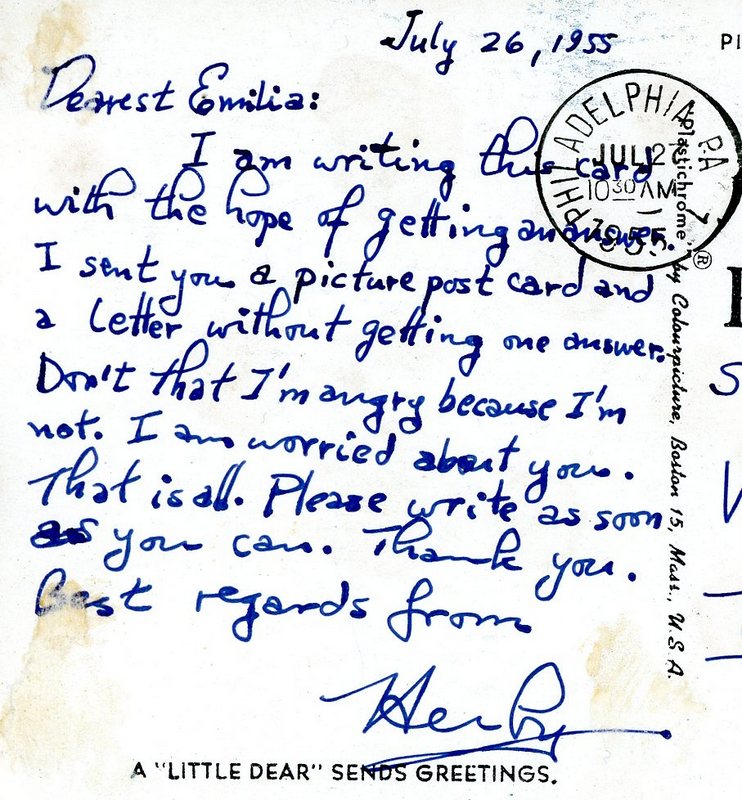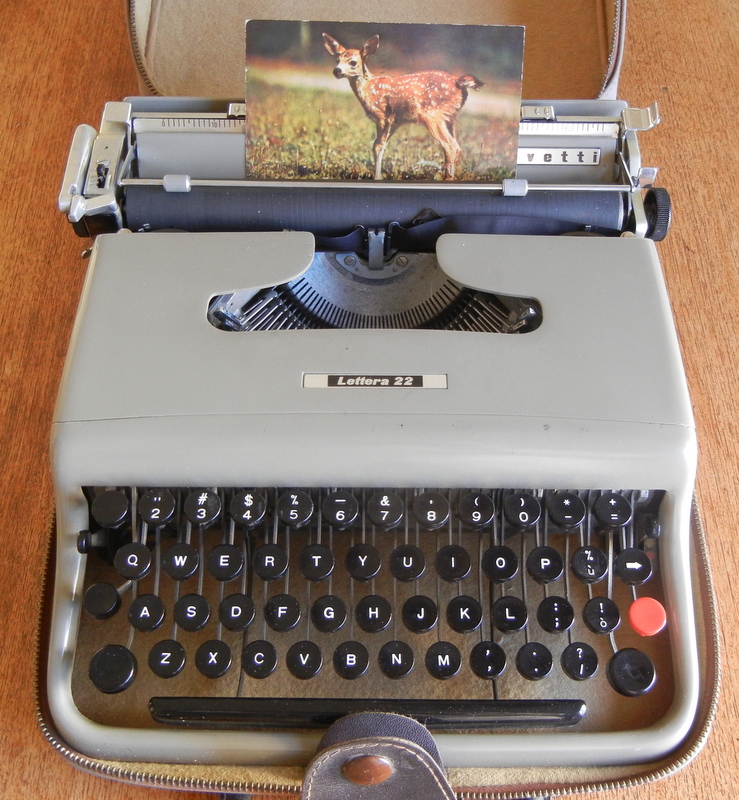
Several weeks ago I found this old postcard at a thrift store. The message was so fascinating that I wrote a song about it, called “Post Cards”, changing the name of Herby to Paul for the sake of the rhyme. A week or two later I returned to the store to find an Olivetti Lettera 22. Later when I got it home I noticed that on the outside of the case, written in faded ballpoint, was the name of the owner; Emilia of the post card! The typewriter is interesting, with Italian accented vowels that do not show on the key tops. Keys 2, 3 & 4 shifted are a, i & e with back-sloped accent marks. The other two vowels u & o are clearly marked on their respective keys.
Emilia’s typewriter, with the picture postcard from Herby
A recent addition to my collection of assorted junk-store treasure was this old wristwatch, which I got for a few bucks in a big haul of stuff, including a nice Lettera 31 typewriter (more about that later). Thus I don’t know what the watch cost me, but the tag was $10, so it was considerably less than that. The tag was on the back, so I had no idea what it covered up until later when I got home and peeled it off. Suddenly I realized the significance of the label. WOLFSBURG. The place where Volkswagens were made. I have owned a few VW’s, starting with a 1970 type 2 that I bought in Amsterdam for $1000 and took a long trip around Europe in. I drove various Beetles from time to time, but never did own one of my own. Today they cost a ridiculous amount. My 1984 VW Westfalia camper is 40 years old and still going strong. We will be camping in it in a couple of weeks. Despite the dead simplicity of the VW van, the utter lack of luxury, the noise, the poor fuel economy and the low power, I enjoy travelling in this vehicle more than any other. Visibility is superb, and it does everything I need, without a fuss. I think it is possibly the greatest vehicle ever made. It is also the only car model I know of in which the owners always wave at each other.
My extensive research (you know what) revealed that Wolfsburg watches were presented to Canadian VW owners whose vehicles hit 100,000 kms. I’m sure my Westy qualifies for this watch, although the real mileage on the van is unknown. After 40 years however, I think it’s safe to assume it has travelled well beyond 100k, probably 2 or 3 times. Needless to say, no car companies give prizes to customers anymore. You’re lucky if they even know how to fix your car!
The movement is a Jeambrun 26D, made in France, from the 60’s, older than my Westy! I cleaned up the case and the crystal with some old Brasso, the kind they no longer sell, but which works like a hot damn on metal and plastic. So far the watch is keeping good time. I think I will wear it when we go for our camping trip. Of course I will! It’s the people’s watch. The Volkswatch!
I recently wrote a song entitled “What Were You Thinkin?” about a stolen Lincoln. The best picture I could find on line was this:
Internet search result
I wanted something closer to what I imagined the stolen Lincoln would look like, so I consulted Microsoft Co-Pilot, and it generated this montage, complete with the lawn and a trailer home; much closer to what I was thinkin! So far I haven’t asked for Co-Pilot to put a baseball team inside the car, but that might be interesting…
Microsoft AI generated image
Here is a clip of the first verse and chorus from my demo, recorded on a cell phone. I was using the camera to record video when I did this one, but I have switched to using Dolby On, a free app that produces surprisingly good quality audio recordings.
(G) It gets 3 miles a (E7) gallon and the (A7) steering (D7) sucks (G) But the trunk is as (E7) big as a (A7) pickup (D7) truck It (C) corners worse than a (G) Greyhound (E7) bus Takes (A7) premium gas and it’s (D7) riddled with rust The (C) seats are torn and they’re (G) growing (E7) mould It’s a (A7) colour combination of (D7) brown and gold You can (C) fit a baseball (G) team (E7) inside It’s the (Am) same old (D7) heap in which (G) Kennedy died
(G) What were you (C) thinkin’ (C) When you stole my (G) Lincoln (G) Last night it was (A7) parked on the lawn (A7) But this (D7) morning it was gone (D7) What were you (C) thinkin’ (D7) When you stole my (G) Lincoln
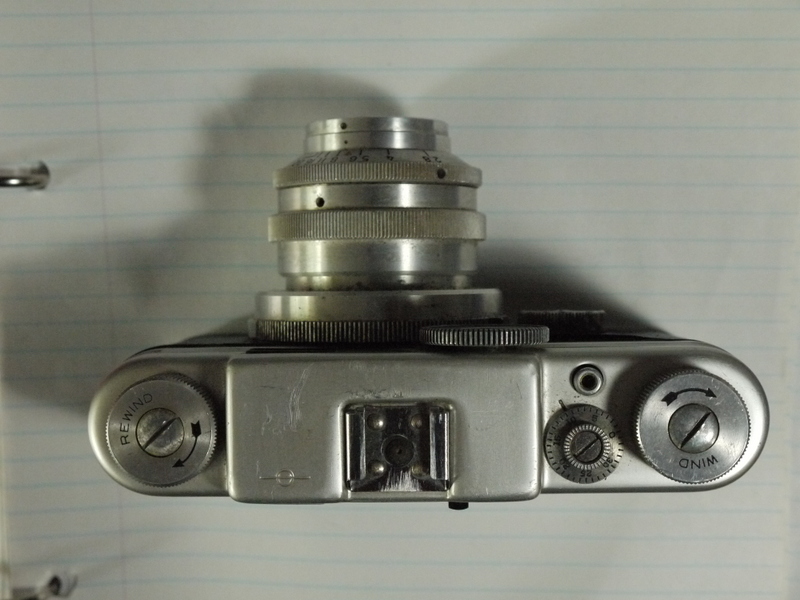
When photography gets too easy it becomes boring. So here I present some recent photos I developed at home, taken with an ancient Speed Graphic with a 120 roll film back, through a Zeiss Tessar lens. Unfortunately, I left the film in the camera for 3 years before I shot the last 3 frames, so it didn’t survive the various light leaks. But a few shots were interesting enough to scan and crop and tidy up. The film is HP5+, and the developer is Caffenol delta standard, a simple mixture of washing soda, vitamin c tablets and cheapo instant coffee. One warning, always filter the solution after mixing it up, or else be prepared for white spots on the negatives due to the presence of tiny bits of vitamin c tablets!
Below are a two photos from a recent musical event, taken with a 1952 Leica iiif on 35mm HP5+ film, and developed in the same Caffenol. The lens is a Summar 50mm from 1935 or so, and it still kicks! When you hold an old Leica in your hands you understand why they were the gold standard for decades.
Last, some digital photos with a difference; shot with a pinhole “lens” on my defective Pentax K50 that still works in manual mode. I was able to shoot outdoors handheld at speeds around 1/20th and ISO of around 12500 to 25000.
I found this ancient Royal 1 that was in terrible shape cosmetically, but upon inspection I wagered that it was fixable, so I bought it. Liberal applications of Deep Creep penetrating oil helped free up many sticking parts, along with some elbow grease and a wire wheel on my Dremel to remove the surface rust. There were two broken parts; the advance lever linkage and the “ear” of the yoke that limits the travel of same. I made a new link from a piece of aluminum, which fixed that issue. The ear proved to be unnecessary. I took off the platen and all the cover plates and did what I could to adjust the inner gears and so on. The spring motor needed a string and winding, which had to be done by winding the thing up and fastening the cord to it. The engineers designed a spring winding mechanism, but I was unable to free up the rusted set screw that locked the winding shaft. Other than that, the thing still works!
I glued the rubber sleeve back onto the wooden platen shaft, and saw that the shaft had been stamped with the date Aug 19, 2012. By the serial number this was the 77,879th of these made. They started production in 1906 and it increased yearly by large leaps. The machine weighs exactly 10kg, and the frame is made of heavy plate steel that is almost indestructible. I put a new spring on the bell, which rings brightly now. All in all this is a very impressive unit, and a testament to the skill of the designers and builders.
I kept notes about the process in a notebook I had, in which I had previously made notes about an interesting book called Fermat’s Enigma, about the history of mathematics. Hence some ruminations on that, typed on the “refurbished” typewriter.
side view
new feet made from wine bungs size 5.5under renovationribbon reversing gearshift leverthe motor housing teeth drive the ribbon winding transmission – like a huge wristwatchmainspring
Olivetti mechanics in an Underwood body: Italian engineering, American design, made in Spain
Bought this Underwood 450 the other day. It was all stained and dirty but Brasso and Meguires plastic cleaner polished it up nicely. I naturally assumed that since it was an Olivetti inside, it had to be Italian design, but it was not. It is an American design! However, Underwood was owned by Olivetti and so the design had to be Olivetti approved, hence I call it Italian Style! Concurrently, I also found a Borsolino cap at last, as well as an Italian merino wool cardigan. I wanted a Borsolino hat for years but never found one until today. Perhaps if I sit down at the “Italian” typewriter in my Italian Borsolino and Italian Merino (sweater), I will write about how I once saw a dead dog in Venice, and how my life was forever changed.
Me and my Italian clothesBorsalino- accept no substitute!
Best Wishes for a Happy Christmas & a Healthy Prosperous New Year in 2023
WAITING FOR WINTER
When I was a lad in deep dark November Wishing and hoping and watching for snow Desperately yearning for ice in December When once again I’d have somewhere to go
Snowflakes were falling the ice rink was calling Shovels came out of the shed Clearing a path from the front to the back As the snow piled up over my head
The milkman, the bread man, the mailman, the trucks Ploughing along through the snow Snowmen and snowballs and hockey pucks Off to the rink we would go
Along comes Christmas at the end of December Everyone’s come out to play Meeting my pals at the rink I remember Nothing felt better than skating all day
Shopping for presents for Mom and Dad Wondering what to get them Mom got some Yardleys and Dad got Old Spice I never will forget them
March brought the spring and the ice soon melted Skating was done for the year But the eternal snow just kept falling and falling Oh when will the summer be here
A couple of weeks ago I found this old 1960’s era Harmony Sovereign guitar for sale at the Sally Ann, cheap! The nut and tuners were gone and the top was damaged, cracked and warped. The bridge was loose and had been bolted into place. But otherwise the rest of it was in reasonable shape.
INJECTING STEAM INTO NECK JOINTSERIOUS DAMAGE AT THE NECK JOINTDOVETAIL NECK JOINT
I removed the neck using steam and a special jig. These old Harmony guitars were glued with hide glue, a fortunate thing since that glue dissolves with heat and steam, enabling disassembly. The top was so damaged that I removed it, but upon inspection it was not worth repairing, so I made a new top. They built these tops with so called “ladder bracing”, no doubt to save cost, but they all fail in time because that is a bad design and cannot adequately resist the string tension over many years. To make things worse, ladder bracing may please some ears but it is almost never used anymore because it produces inferior tone in the main opinion. Some folks like it, but I am not a fan. No quality guitars are ever built with ladder bracing these days (that I know of).
OLD TOP WITH MISSING BRACE, CRACKS, & BOLTS!NEW CEDAR TOPNEW TOP SHOWING THE BRACES
For the new bracing I went with the V brace design that I’ve used for the last 4 guitars I made. This is a proven design that has lots of advantages over ladder bracing and the common x bracing. For one thing it is extremely simple. It puts the main axis of strength in the same direction as the main deforming forces, which means it is more efficient regarding strength to mass, thus enabling less mass in the bracing. Less mass equals more efficient movement of the soundboard, and more sound, especially in the lower register. The low register is where steel string guitars tend to have problems, because many builders over brace them to ensure that the tops don’t warp under tension, which of course limits the low frequencies that are so desirable. It is not hard to get high frequencies out of a steel string guitar, but good bass is another thing. I like v braces for this reason. However, they are so darned effective that you can easily over design them. Therefore I took the two main braces down to a mere 10mm this time, because on previous guitars of similar size I had to go in after they were built and plane the braces down to around that height in order to loosen up the tops and get the bass going.
INSIDE THE OLD BOX AFTER A LOT OF CLEAN UPI CHAMFERED THE TAIL BLOCK TO REDUCE THE GLUED SURFACE
After a lot of testing of neck angle and what not I assembled the top, put on binding, and glued the neck back in place. Everything was perfect, but then I had second thoughts about the bridge. My design called for a typical glued on bridge with pins, which I was sure would work well enough. However, while waiting for the new bridge to arrive in the mail, I thought I would test the guitar with a floating bridge and a tailpiece. I had a suitable tailpiece that resembled those from some old Harmony and Stella guitars, and I made a bridge from a piece of maple. After I got it strung up I was pleasantly surprised to find that it sounded great, and very sweet toned with lots of bass. In short, perfectly acceptable for my purpose. So I left it that way. There is very little pressure on the bridge, and yet the guitar has plenty of volume and punch. So much for all those guitar experts who go on and on about break angles. There is no end of pseudo science among guitar nerds and luthiers; so beware of bullsh*t and trust your own ears!
Lately I’m into songwriting. I know I should have started earlier if I want to be rich and famous but I was busy. Better late than never, right? Yesterday I was fiddling around on the guitar as usual, waiting for an idea or the beginning of an idea, while putting together various chords. This is how it seems to work for me, messing with chord progressions and imagining a tune to go with them. Sometimes I get ideas for lyrics first and work with that, but this was just some chords. I wrote 16 bars, a common verse length and then waited for further instruction from the subconscious. Somehow this reminded me of a sea song, you know them, lyrical and all about waves and sailors and puking etc. Then it struck me that Charles Darwin spent 5 years at sea on the Beagle, and the poor guy suffered from sea sickness!
So, out came The Ballad of Charles Darwin from nowhere, or so it seemed. With all the ballads about heroes and villains and sad cases, I had never heard of a song about Charles Darwin, so it seemed to be a reasonable idea. After all, the man started a revolution with a book! The odd coincidence happened today, when I found out that today is “Evolution Day”, in recognition of the date of publication of Darwin’s earth shaking book, On The Origin of Species, on November 24, 1859 (On the Origin of Species by Means of Natural Selection).
As of this minute, I’m still working on the song, getting the melody down and messing with various chord substitutions, trying to make it good and also original. But as Mies van der Rohe was said to say: it is better to be good than original. So I try to not be so original that the tune sucks. This applies to architecture and music alike, in my opinion. Of course, to be original and be good is to have the best of everything, a challenging task. I wish I had started writing songs when I was 11, as by now I might have some really good ones. However, I now have the advantage of 60 years of practice on the guitar, as well as a lifetime of experiences to draw on, which is helpful when you want to tell a story.
Hello everyone! As a proud Dad I am thrilled to announce my son’s new venture – BOOKBUZZ.ORG.
Over a year ago Terry (the bearded one) quit his old job as a software engineer at Amazon and has been working full time building a state of the art search engine devoted to finding books sold by the independent booksellers of the world. There are other book searching sites, but Book Buzz is different; fast, efficient, and simple enough for the least technically inclined. If you think small is beautiful and support local and independent businesses, you will be pleased to learn that Book Buzz is all about that! When you use Book Buzz you will also be supporting Terry and his family (the little ones).
The Blurb
BookBuzz.org is a new search engine for booklovers who want an alternative to Amazon. Our mission is to simplify the process of online shopping for books and to support the independent book community.
You search for the book you want. We display offers from independent bookshops, booksellers and online marketplaces.
We do not display listings from Amazon or its subsidiaries.
Our intelligent search helps you find the exact title that you need. Our search results display the cheapest offer for the book you want. We show new and used copies. Shipping is included in the prices we display.
Features
Bookbuzz searches the databases of its partners such as: ALIBRIS, BIBLIO, BOOKSRUN, BLACKWELL’S, CHRISLANDS, & eBAY, which together comprise a vast number of books from independent sellers down the chain of supply, numbering in the millions. Bookbuzz uses intelligent algorithms to instantly sort and predict the book you are seeking almost as fast as you can type in any keyword. I guarantee you will be impressed! Bookbuzz also features a glossary of terms used in the used book trade, as well as a clear and useful guide to purchasing books.
Last Word
Look for this symbol, and remember the domain is “ORG”. Click the image to go to the site. Thanks for looking!