Tag Archives: v braced guitar top

Sovereign Revival

HARMONY SOVEREIGN MODEL 1203

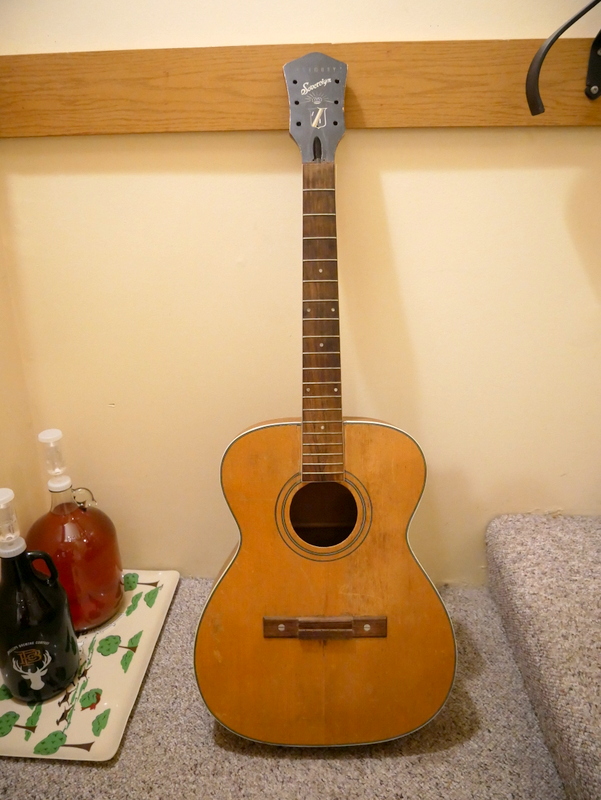
A couple of weeks ago I found this old 1960’s era Harmony Sovereign guitar for sale at the Sally Ann, cheap! The nut and tuners were gone and the top was damaged, cracked and warped. The bridge was loose and had been bolted into place. But otherwise the rest of it was in reasonable shape.
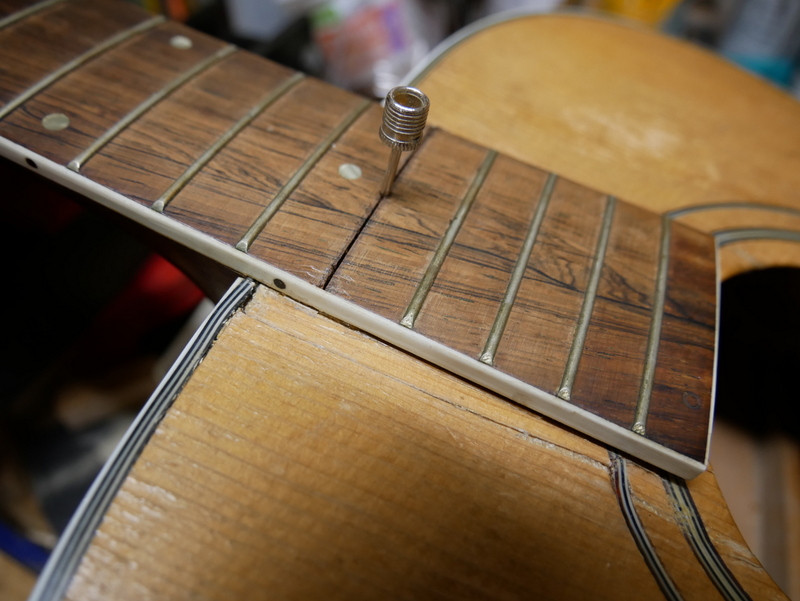
INJECTING STEAM INTO NECK JOINT
SERIOUS DAMAGE AT THE NECK JOINT
DOVETAIL NECK JOINT

I removed the neck using steam and a special jig. These old Harmony guitars were glued with hide glue, a fortunate thing since that glue dissolves with heat and steam, enabling disassembly. The top was so damaged that I removed it, but upon inspection it was not worth repairing, so I made a new top. They built these tops with so called “ladder bracing”, no doubt to save cost, but they all fail in time because that is a bad design and cannot adequately resist the string tension over many years. To make things worse, ladder bracing may please some ears but it is almost never used anymore because it produces inferior tone in the main opinion. Some folks like it, but I am not a fan. No quality guitars are ever built with ladder bracing these days (that I know of).
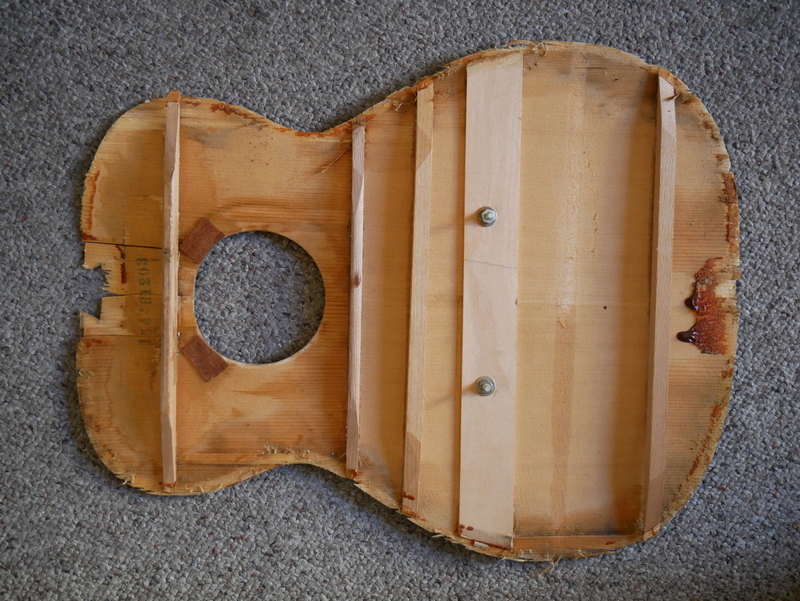
OLD TOP WITH MISSING BRACE, CRACKS, & BOLTS!
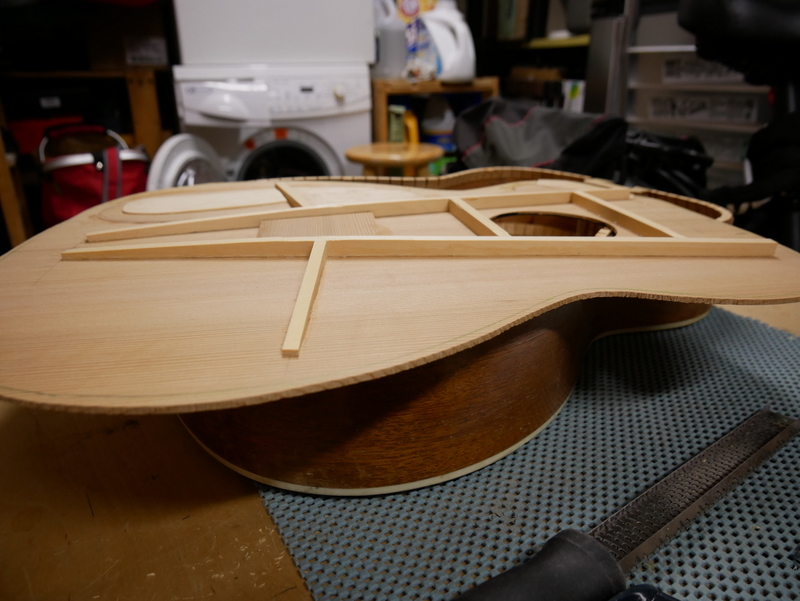
NEW CEDAR TOP
NEW TOP SHOWING THE BRACES

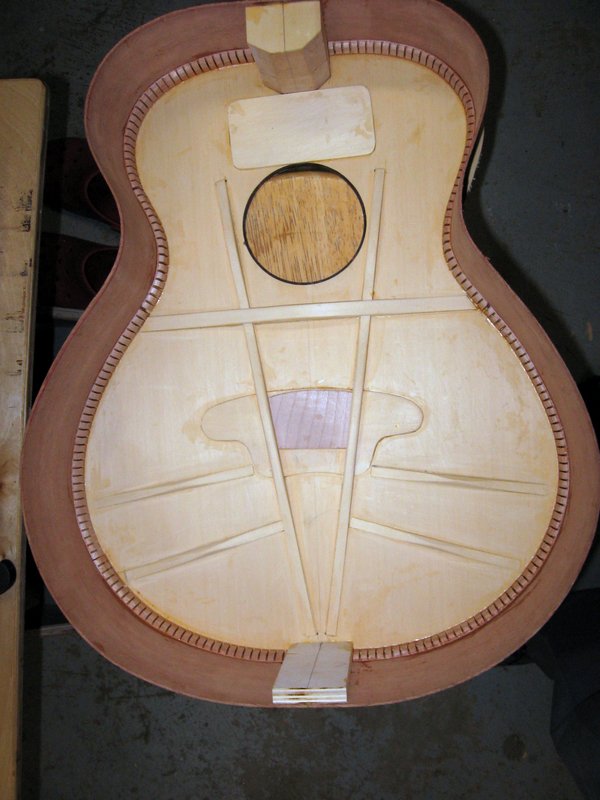
For the new bracing I went with the V brace design that I’ve used for the last 4 guitars I made. This is a proven design that has lots of advantages over ladder bracing and the common x bracing. For one thing it is extremely simple. It puts the main axis of strength in the same direction as the main deforming forces, which means it is more efficient regarding strength to mass, thus enabling less mass in the bracing. Less mass equals more efficient movement of the soundboard, and more sound, especially in the lower register. The low register is where steel string guitars tend to have problems, because many builders over brace them to ensure that the tops don’t warp under tension, which of course limits the low frequencies that are so desirable. It is not hard to get high frequencies out of a steel string guitar, but good bass is another thing. I like v braces for this reason. However, they are so darned effective that you can easily over design them. Therefore I took the two main braces down to a mere 10mm this time, because on previous guitars of similar size I had to go in after they were built and plane the braces down to around that height in order to loosen up the tops and get the bass going.

INSIDE THE OLD BOX AFTER A LOT OF CLEAN UP
I CHAMFERED THE TAIL BLOCK TO REDUCE THE GLUED SURFACE

After a lot of testing of neck angle and what not I assembled the top, put on binding, and glued the neck back in place. Everything was perfect, but then I had second thoughts about the bridge. My design called for a typical glued on bridge with pins, which I was sure would work well enough. However, while waiting for the new bridge to arrive in the mail, I thought I would test the guitar with a floating bridge and a tailpiece. I had a suitable tailpiece that resembled those from some old Harmony and Stella guitars, and I made a bridge from a piece of maple. After I got it strung up I was pleasantly surprised to find that it sounded great, and very sweet toned with lots of bass. In short, perfectly acceptable for my purpose. So I left it that way. There is very little pressure on the bridge, and yet the guitar has plenty of volume and punch. So much for all those guitar experts who go on and on about break angles. There is no end of pseudo science among guitar nerds and luthiers; so beware of bullsh*t and trust your own ears!
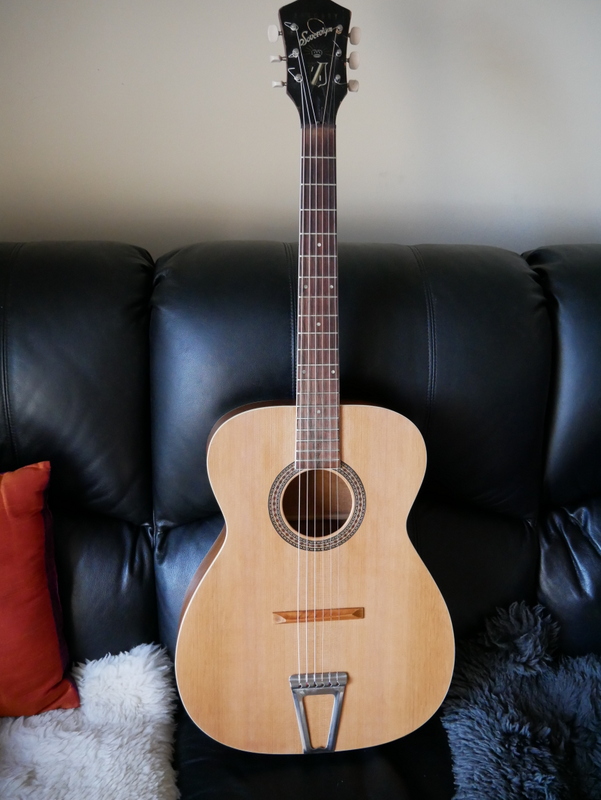
THE ALL NEW OLD HARMONY SOVEREIGN

2 Comments

Filed under Guitars, Uncategorized

Back to Folk Singing

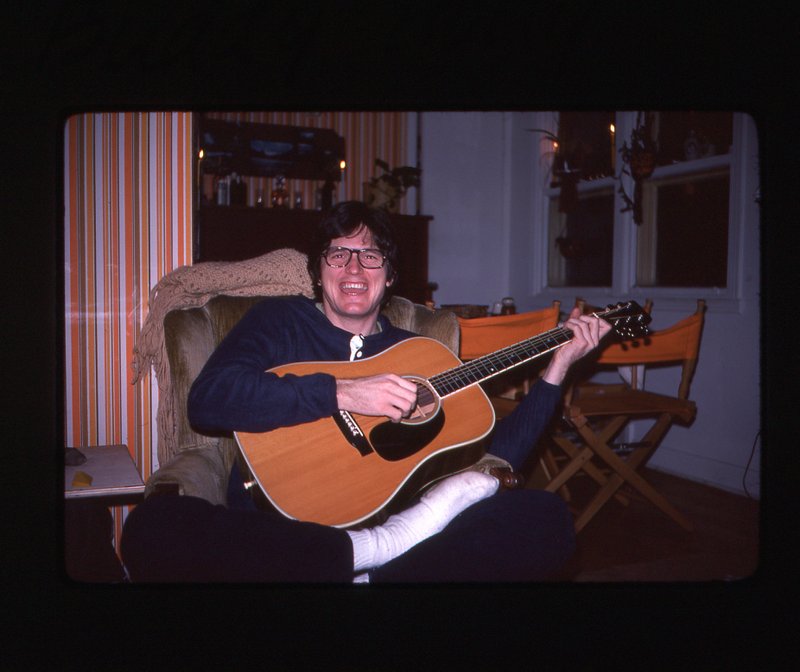
49 years ago I bought the guitar of my dreams, a brand new Martin D35. In those days I was in love with Gordon Lightfoot songs, the Beatles of course, and all that music that sounded great on a big flat top guitar.

My late friend Bob Wylie strumming my D35 c. 1977

But the years passed and so did my taste in music, so 24 years ago I sold the D35 and moved on to jazz. However, the circle of life comes around like the seasons and so I recently decided it was high time I had a big “folk” guitar again. The Martin dreadnought, or D type guitar is the most copied guitar in the world, because it is like a battle ship that fears no man or woman. But it is big, a bit too big for me now that my shoulder and arm can’t take long hours of being draped over a huge guitar. I checked around and found the next best thing – a Taylor Grand Auditorium. This guitar has a narrow waist that allows it to sit lower and thus is less painful on the strumming arm. It was designed to compete with the Dreadnoughts, and by and large it can, although it’s a little smaller. The D size guitars are very large and in the opinion of many guitarists the 000 Martin is the acme of flat tops. While I tend to agree, I had already built one of those many years ago, and I wanted something different. Hence the latest guitar – my version of a Taylor Grand Auditorium, complete with the “all new, improved V bracing”.

Here is my latest guitar, #37, successor to my long gone D35, which I expect is still out in the world being strummed somewhere.

The famous C chord, beloved of folkies everywhere!

Taylor is converting their guitars to this v shaped bracing system, away from traditional x braced tops. They claim to have invented it, but it’s been around a long time in one form or another. I just copied their design however, figuring they had already done all the testing for me. I played a few examples and while they were no better than some of their x braced guitars, it seemed like an adventure to try a new design. I already made several ukuleles with v braces and I knew they sounded really good, better than the fan braced ones I had made before.

The guitar sounds great for folk music, no good at all for jazz, which is how it should be. I already have a dozen jazz guitars!

V braced top, a la Taylor. They patented this. Didn’t stop me.

For the record: cypress top, cypress braces, African mahogany body and neck, rosewood fingerboard, ebony bridge. Tuners are Gotoh 510, 1:21, the smoothest damn tuners on earth and worth every cent of the hundred bucks they cost. Strings are D’Addario EJ15 phosphor bronze, extra light. Even with extra light strings this thing is loud. I might up the gauge when I change strings, but the trade off is more volume for more work, and I have lazy old fingers.

Body is 16″ x 20″ x 4 5/8″ deep, same as Martin D. The nut is 1 11/16″, exactly the same as my old D35, as is the bridge. Scale length 25.5″, just a tad longer than Martin’s 25.4″ scale, so it feels like a D35 in my hands. Now to go practice “Did She Mention My Name”. Today’s pop music is so banal and crappy it’s not worth listening to, so thank heavens we have Gordon Lightfoot, who is still alive! He should have got the Nobel Prize, not Bob Zimmerman… the worst performer I have ever seen. But BZ wrote some good songs. I may play one of those later.

4 Comments

Filed under Guitars, Music, Uncategorized