

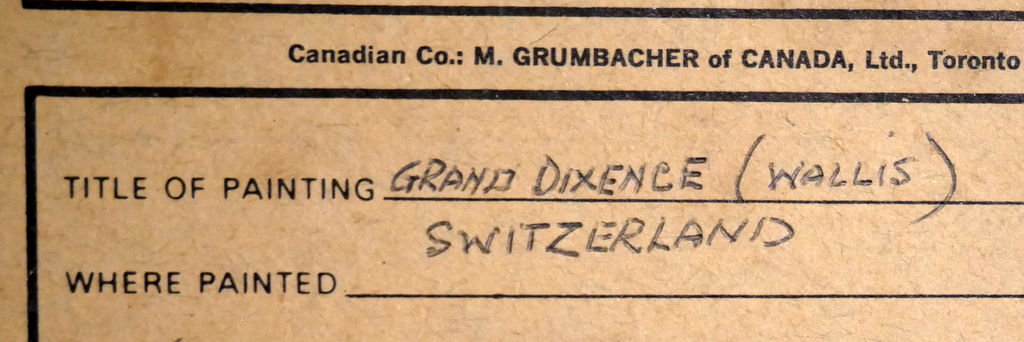
The local St Vincent de Paul thrift store recently moved to a new location closer to our home and so we have been going often in search of whatever may be found. Two interesting unrelated items I picked up for a couple of bucks were an old oil painting of an Alpine scene in a nice frame, along with an old Cadet Officer’s Commission from the County Palatine of Lancaster. Prior to that day I knew nothing whatsoever about County Palatines or the Alpine scene, which the painter identified in handwriting on the back of the painting as being “Grand Dixence”.
Further investigation followed, and I discovered the exact spot from whence the painting sprung, as well as the history of the Grand Dixence, a huge dam high in the Swiss Alps. Here is the painting and a photo I found on line, unquestionably from the same place.
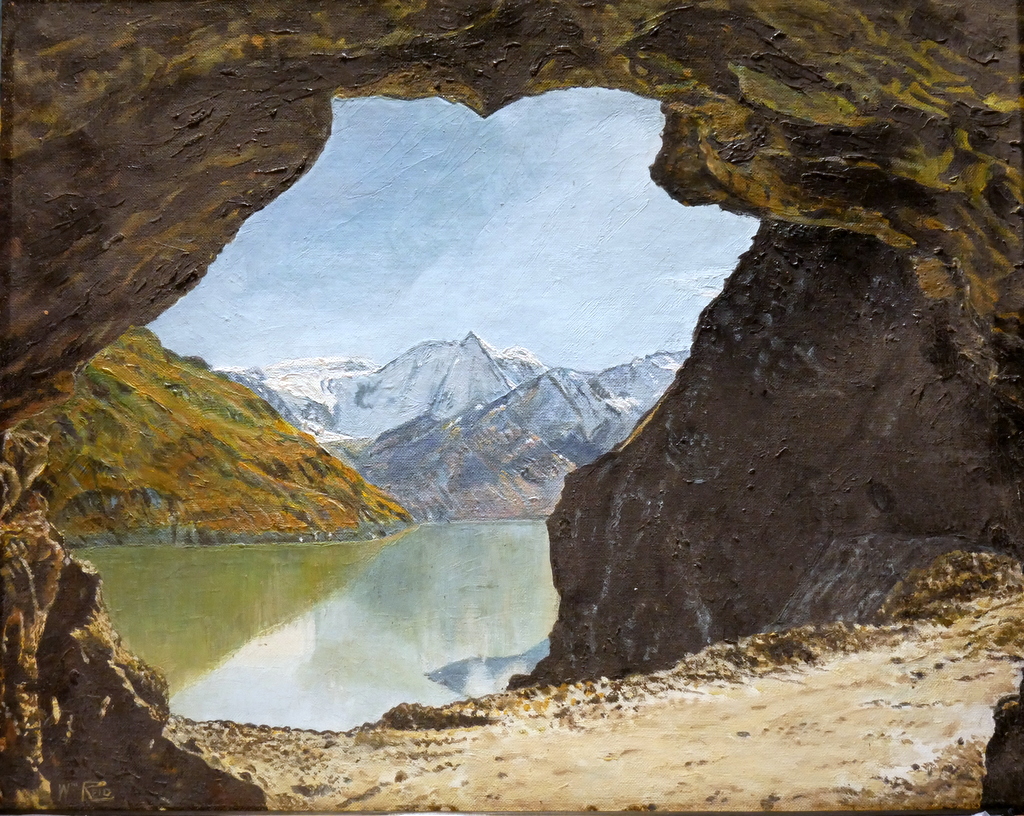

The Grand Dixence dam was built in the 1950’s and is the largest gravity dam in the world. My guess from the top picture is that the painting and photo viewpoint is very likely to be somewhere along the shoreline to the left of the far end of the dam. Just a guess of course.
As for the County Palatine, the certificate I found was in antiquated language granting a commission in the Catholic Cadets to a young man, under the authority of the Lord Lieutenant and Custos Rotulorum of the County Palinate of Lancaster, the Honourable Ughtred James Baron Shuttleworth of Gawthorpe.
Custos Rotulorum means keeper of the rolls in latin, and is an ancient office, being the person who keeps the public records.


From Wikipedia: Palatinates emerged in England in the decades following the Norman conquest, as various earls or bishops were granted palatine (“from the palace”) powers, i.e. powers of a sort elsewhere exercised by the king. Palatine powers over Lancashire were conferred on the first duke of Lancaster in 1351, at the same time as his promotion from the status of earl. This was only the second dukedom created in England, following that of Cornwall in 1337, which also became associated with palatine powers. The dukedom was united with the Crown on the accession of Henry IV in 1399, but the vast estates of the Duchy of Lancaster were never assimilated into the Crown Estate, continuing even today to be separately administered for the monarch as Duke of Lancaster. The rights exercised through the Duchy, rather than the Crown, included its palatine powers over Lancashire, the last of which were revoked only in 1873. In the county palatine of Lancaster, the loyal toast is to “the King, Duke of Lancaster”


 nathanguitars