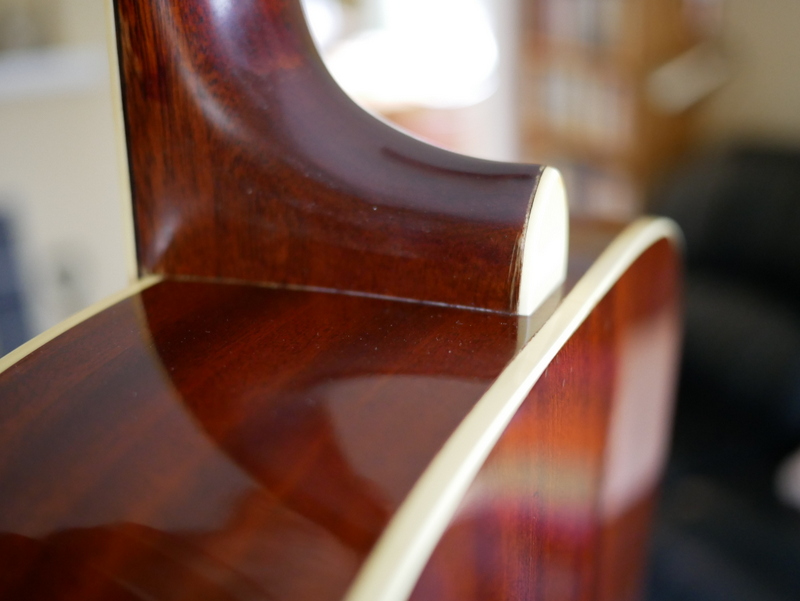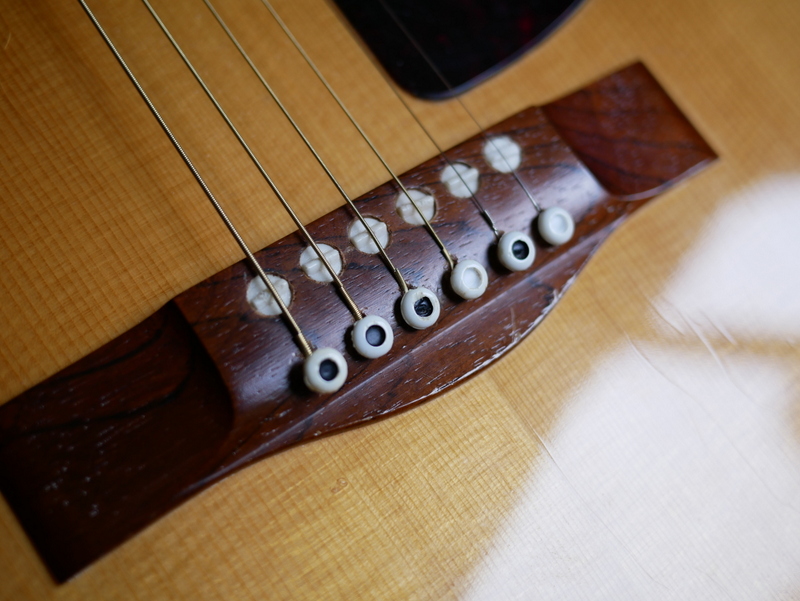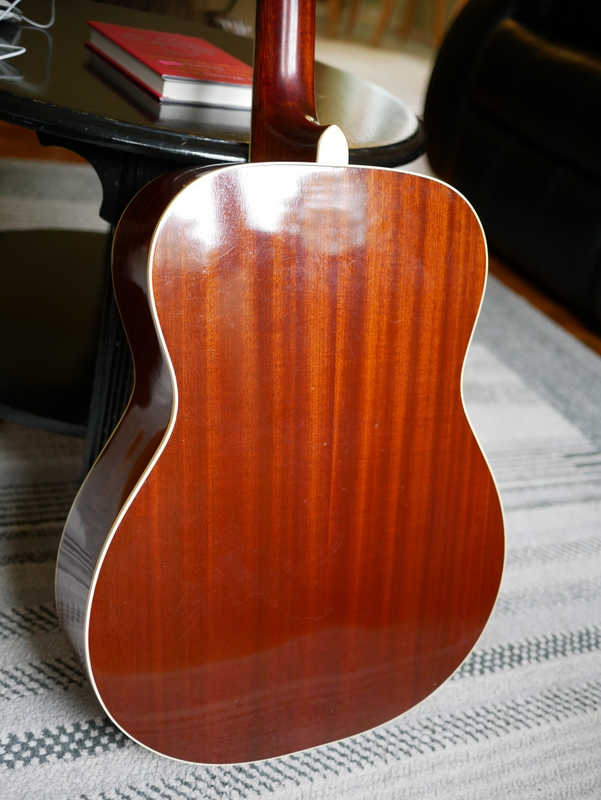
I recently built a guitar after two and a half years off. A friend gave me a lovely piece of bear-claw spruce, which I took down from the shelf one day in June and joined together just for something to do. Then I planed it down and sanded it to rough thickness. By this time I realized that I was going to build another guitar, but I didn’t know what it would be. So I went around and looked at guitars in the local music store and decided to make something that looked like my previous big body guitars! These were both copies of the Taylor Grand Auditorium model, but when I delved into this a bit more I discovered that those were very close to the little know Martin models known as J40 and M36. The main difference being the body depth. So I settled on something shaped like a Martin M36, which has a 4″ deep body, but with V bracing like Taylor uses, and which I have been using for the last few guitars too.
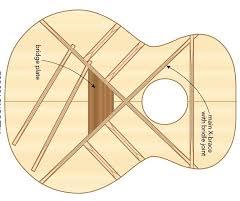
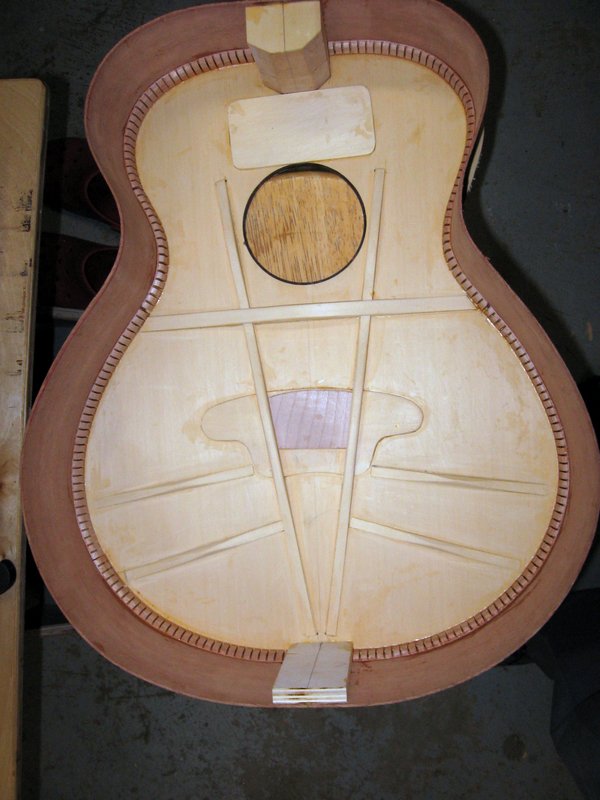
It took me 2 months to build, working slowly and steadily. I have been experimenting with this V bracing and this time I settled on my own version that omits the waist brace. I had already tried this on a guitar or two that I rebuilt, so I was confident that it would work. Basically I simplified the already simple V brace concept by making the 2 main braces one long piece from end to end. Unlike Taylors, this idea needs no waist brace. Despite how great the guitars I made with the waist brace design were, I still figured that the waist didn’t really need that brace if the main braces didn’t get thinner there. So I left off that waist brace and kept the main braces high at that area.
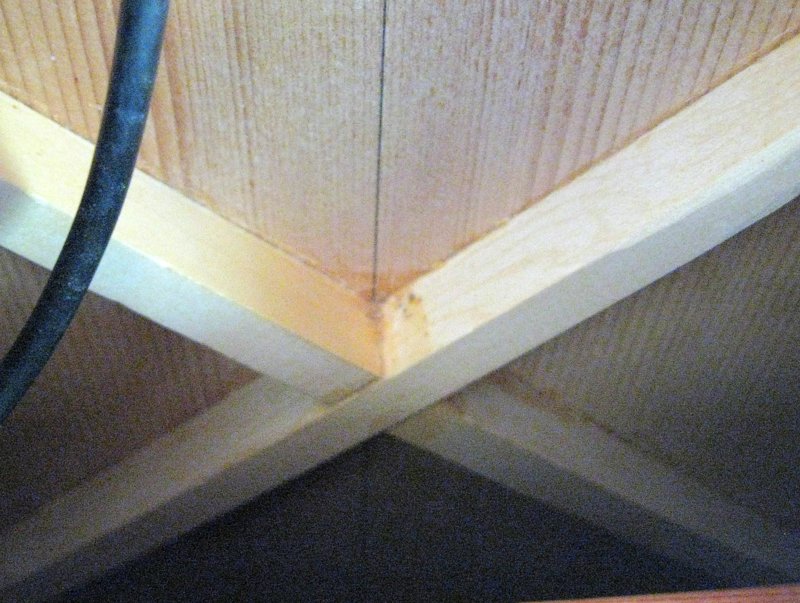
In the spirit of being different again, I braced the back with an X brace, which is the commonest form of soundboard bracing. But heck, it looks good and works great for backs too!
In conclusion, it’s a fine guitar and it has a great sound. I can’t say it’s better than the ones I built with the waist brace, but time will tell how it sounds in the long run. So far, so good – great response from low to high, and very loud. It was an interesting project to build something out of the ordinary. After all, why be ordinary?
If you are interested in reading the whole process, here is my diary of the build, from original hand written notes.
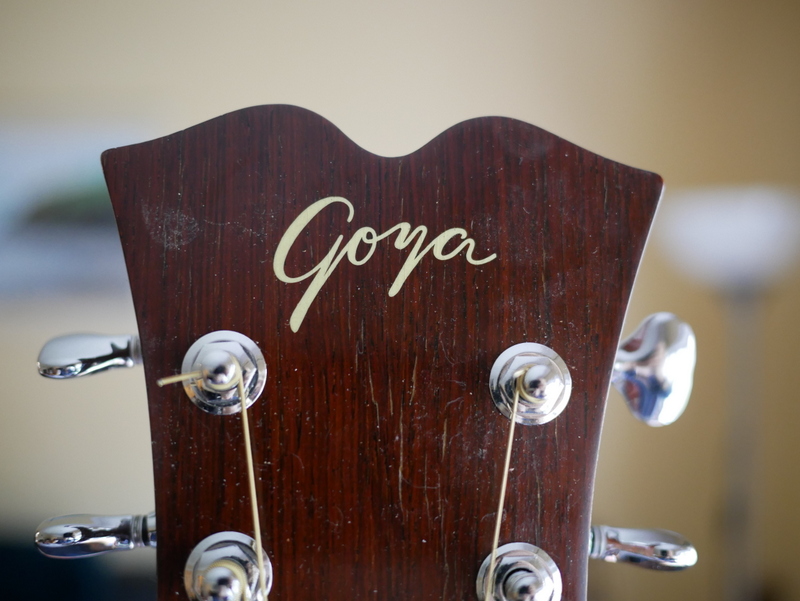
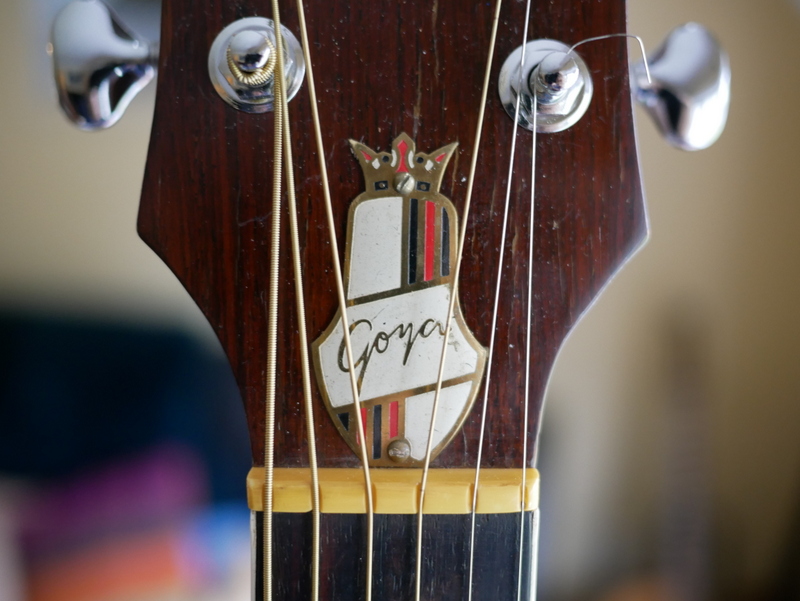
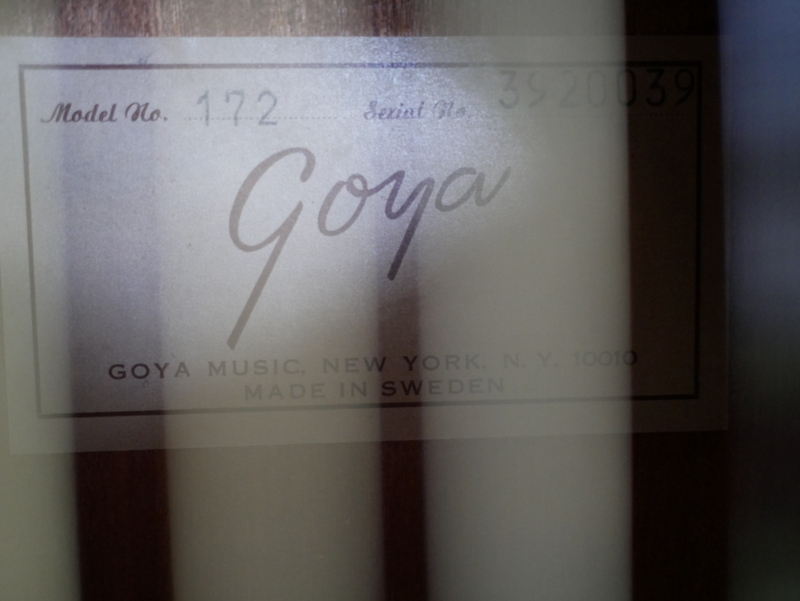
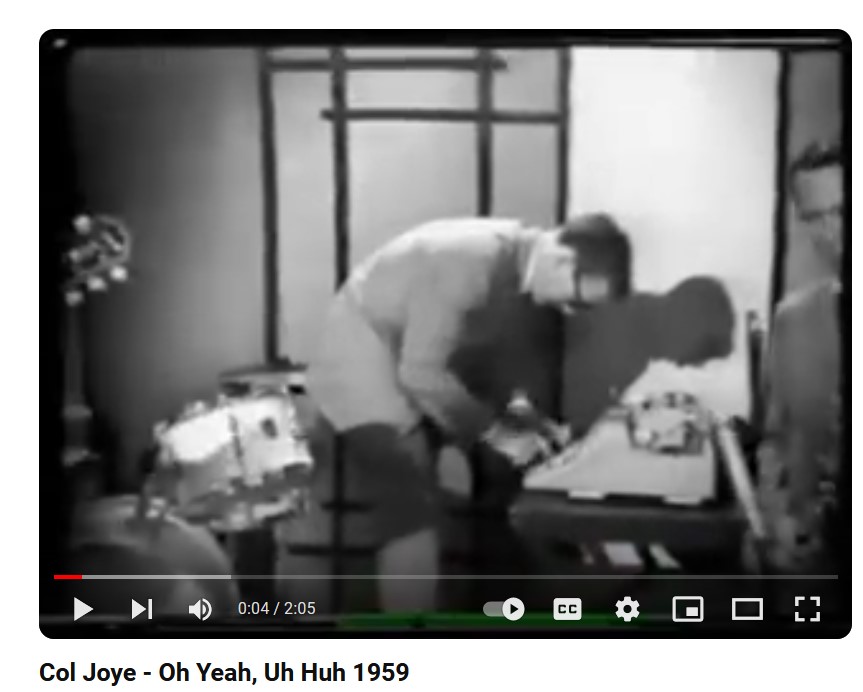
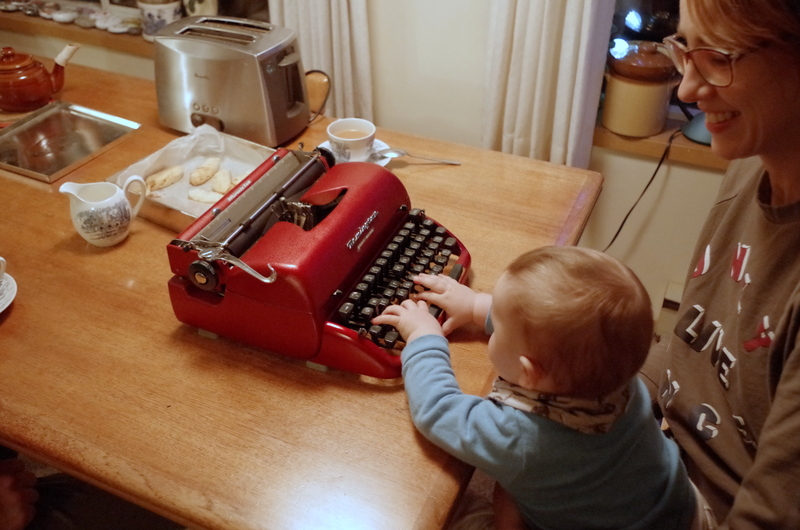
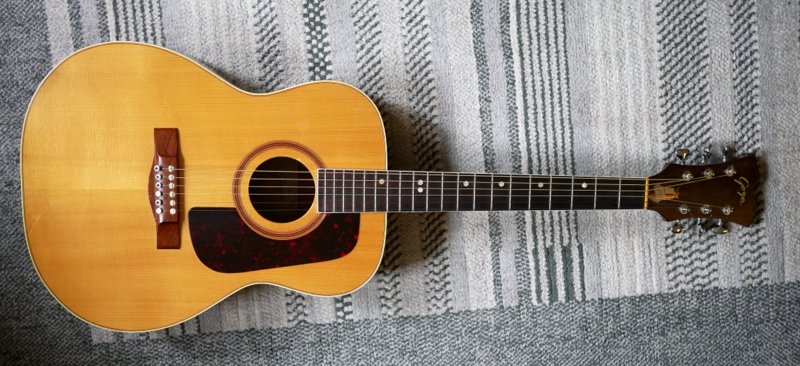
A recent thrift shop find was a very unusual 60 year old Japanese guitar. I bought it because I liked the funky look of it. A search by photo turned up some amazing facts that led me to this clip above of an Australian band from 1959 that featured rhythm by typewriter. That band was led by it’s star singer, Col Joye. He had a line of guitars made in Japan with his name on the label. This is one of them.
My Col Joye guitar after repairs.
It resembles a French gypsy style guitar in construction, having an arched top with ladder bracing as well as a fret marker at the 10th fret. It sounds like a gypsy jazz guitar, very bright and loud. The rosette is a work of art, with delicate inlaid mother of pearl, seriously fancy for a presumably low cost item. The neck has no truss rod, but it does have an inlaid wood bar that acts as reinforcing. The neck did not warp or bow, but slowly bent from the heel over 60 years, as even the best of guitars often do.
I removed and reset the neck, made a new bridge and did a lot of fret levelling to make it playable. One site stated that Tommy Emmanuel owned a Col Joye as his first guitar. How this came to Canada beats me, as they were not sold here.
Neck removal by steam injection. Lucky for me they used hide glue. I used hide glue to reassemble too!Rosette and pick guard detail
I found numerous videos of Col Joye and his band, but the one that amazed me was the performance of Oh Yeah, Uh Huh, which had a guy typing rhythm. The song is forgettable, to be kind, but the video should be priceless to typewriter aficionados. As for the guitar, it is the rarest guitar I have ever owned, and likely one of the few left in the world (just guessing).
Page from an archived Australian website that once had the same guitar for sale.
Tommy Emmanuel, if you are out there, I will gladly trade you this guitar for one you own!
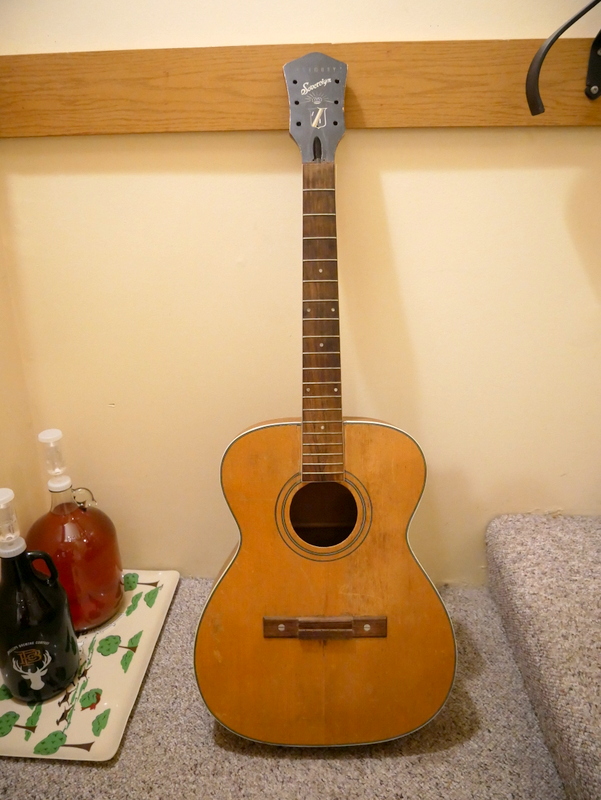
A couple of weeks ago I found this old 1960’s era Harmony Sovereign guitar for sale at the Sally Ann, cheap! The nut and tuners were gone and the top was damaged, cracked and warped. The bridge was loose and had been bolted into place. But otherwise the rest of it was in reasonable shape.
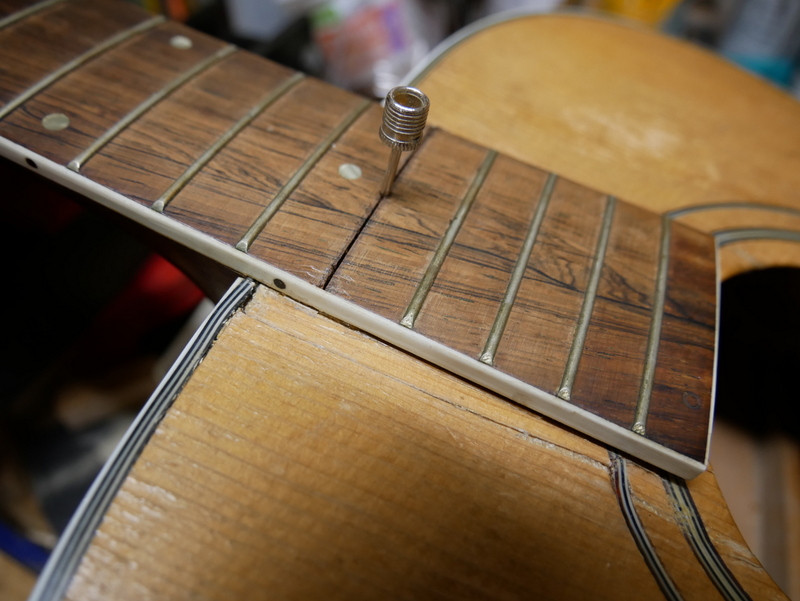
INJECTING STEAM INTO NECK JOINTSERIOUS DAMAGE AT THE NECK JOINTDOVETAIL NECK JOINT
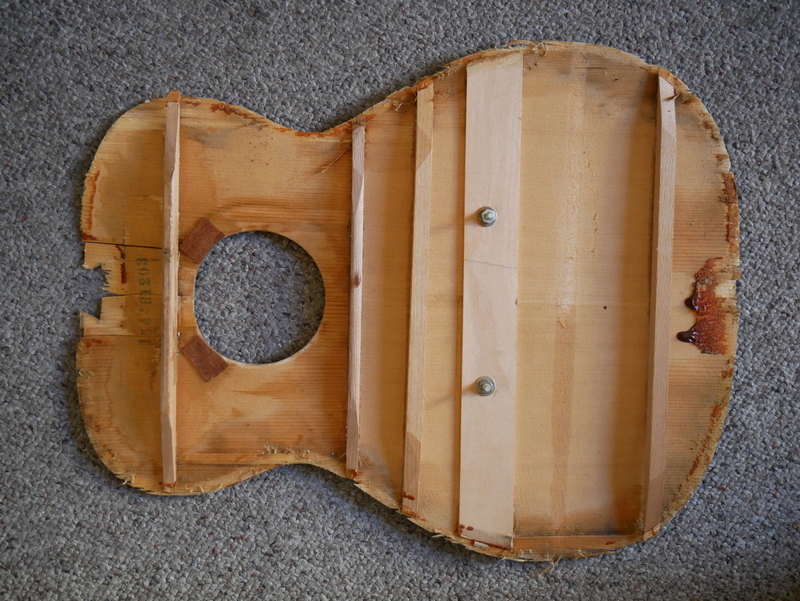
I removed the neck using steam and a special jig. These old Harmony guitars were glued with hide glue, a fortunate thing since that glue dissolves with heat and steam, enabling disassembly. The top was so damaged that I removed it, but upon inspection it was not worth repairing, so I made a new top. They built these tops with so called “ladder bracing”, no doubt to save cost, but they all fail in time because that is a bad design and cannot adequately resist the string tension over many years. To make things worse, ladder bracing may please some ears but it is almost never used anymore because it produces inferior tone in the main opinion. Some folks like it, but I am not a fan. No quality guitars are ever built with ladder bracing these days (that I know of).
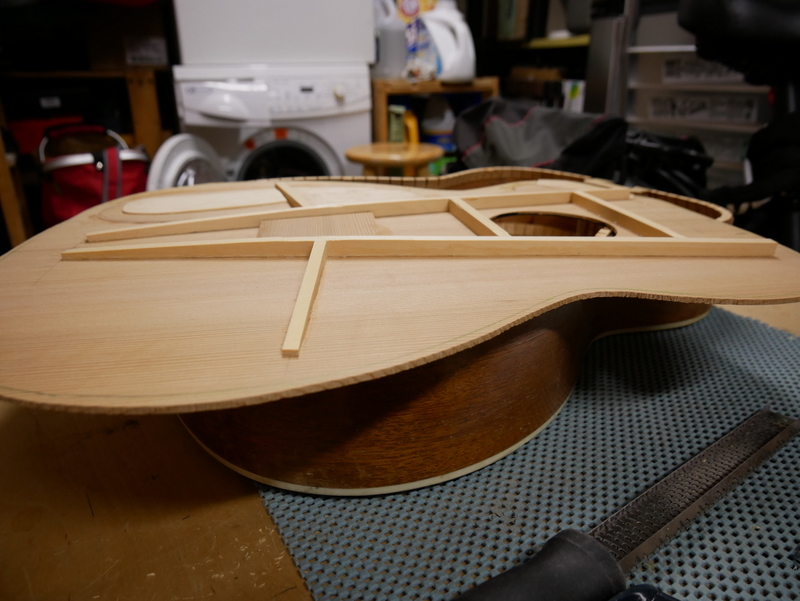
OLD TOP WITH MISSING BRACE, CRACKS, & BOLTS!NEW CEDAR TOPNEW TOP SHOWING THE BRACES
For the new bracing I went with the V brace design that I’ve used for the last 4 guitars I made. This is a proven design that has lots of advantages over ladder bracing and the common x bracing. For one thing it is extremely simple. It puts the main axis of strength in the same direction as the main deforming forces, which means it is more efficient regarding strength to mass, thus enabling less mass in the bracing. Less mass equals more efficient movement of the soundboard, and more sound, especially in the lower register. The low register is where steel string guitars tend to have problems, because many builders over brace them to ensure that the tops don’t warp under tension, which of course limits the low frequencies that are so desirable. It is not hard to get high frequencies out of a steel string guitar, but good bass is another thing. I like v braces for this reason. However, they are so darned effective that you can easily over design them. Therefore I took the two main braces down to a mere 10mm this time, because on previous guitars of similar size I had to go in after they were built and plane the braces down to around that height in order to loosen up the tops and get the bass going.
INSIDE THE OLD BOX AFTER A LOT OF CLEAN UPI CHAMFERED THE TAIL BLOCK TO REDUCE THE GLUED SURFACE
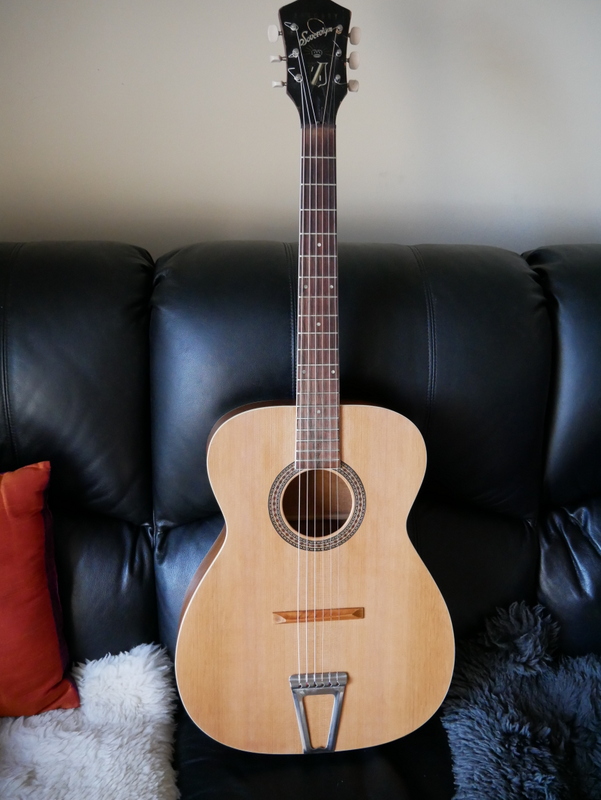
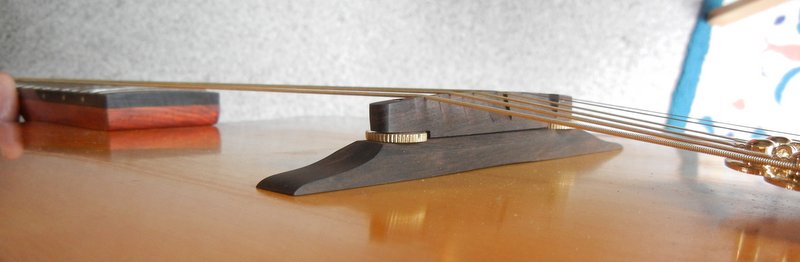
After a lot of testing of neck angle and what not I assembled the top, put on binding, and glued the neck back in place. Everything was perfect, but then I had second thoughts about the bridge. My design called for a typical glued on bridge with pins, which I was sure would work well enough. However, while waiting for the new bridge to arrive in the mail, I thought I would test the guitar with a floating bridge and a tailpiece. I had a suitable tailpiece that resembled those from some old Harmony and Stella guitars, and I made a bridge from a piece of maple. After I got it strung up I was pleasantly surprised to find that it sounded great, and very sweet toned with lots of bass. In short, perfectly acceptable for my purpose. So I left it that way. There is very little pressure on the bridge, and yet the guitar has plenty of volume and punch. So much for all those guitar experts who go on and on about break angles. There is no end of pseudo science among guitar nerds and luthiers; so beware of bullsh*t and trust your own ears!
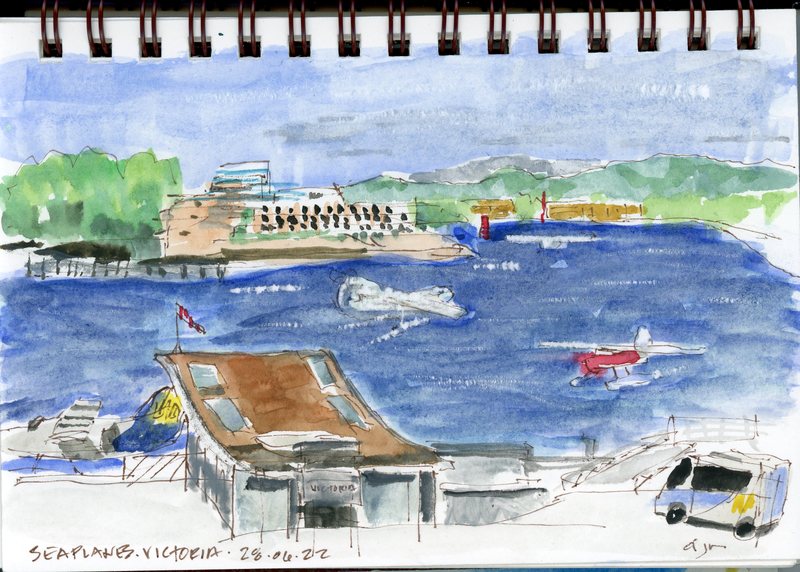
Inner harbour – Victoria BC – an actual international airport. Every plane is an Otter!Braun watch – soon to have new innards! Thank goodness for interchangeable parts.Yamaki dreadnought under repair. Betting this one is great! Solid cedar top, rosewood back and sides.
Yamaki guitars were well made, and many had solid tops. The bracing is a copy of a Martin D28, as is the body size. The scale is a bit shorter than Martin, 640mm vs 645mm. The interior bridge plate is rosewood, indicative of high quality. Cheap guitars have spruce. One thing I don’t like is the thick lacquer on the top. I might strip it off, which should improve the tone. A poor man’s D28 for about $50 after I buy tuners and strings.
A pair of JP-1’s. Both work perfectly, after a bit of TLC.
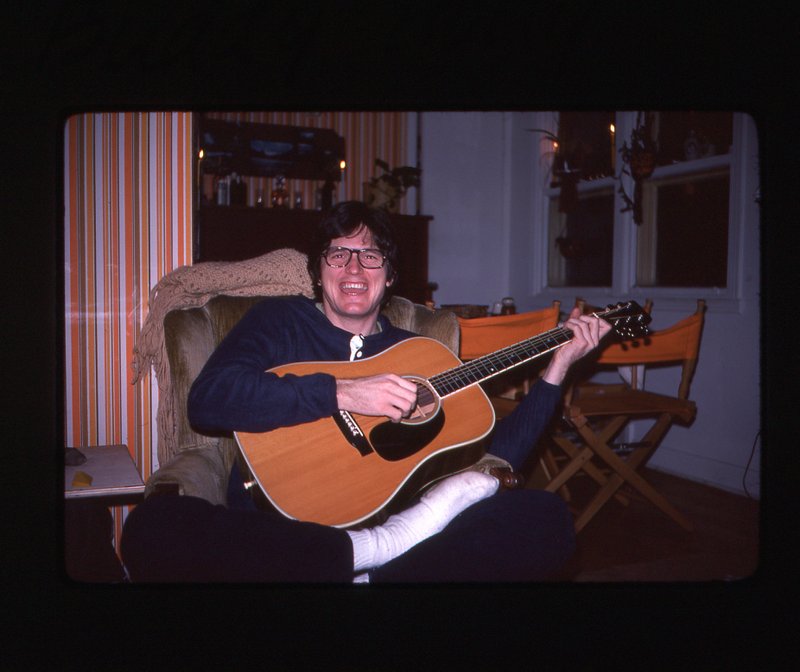
49 years ago I bought the guitar of my dreams, a brand new Martin D35. In those days I was in love with Gordon Lightfoot songs, the Beatles of course, and all that music that sounded great on a big flat top guitar.
My late friend Bob Wylie strumming my D35 c. 1977
But the years passed and so did my taste in music, so 24 years ago I sold the D35 and moved on to jazz. However, the circle of life comes around like the seasons and so I recently decided it was high time I had a big “folk” guitar again. The Martin dreadnought, or D type guitar is the most copied guitar in the world, because it is like a battle ship that fears no man or woman. But it is big, a bit too big for me now that my shoulder and arm can’t take long hours of being draped over a huge guitar. I checked around and found the next best thing – a Taylor Grand Auditorium. This guitar has a narrow waist that allows it to sit lower and thus is less painful on the strumming arm. It was designed to compete with the Dreadnoughts, and by and large it can, although it’s a little smaller. The D size guitars are very large and in the opinion of many guitarists the 000 Martin is the acme of flat tops. While I tend to agree, I had already built one of those many years ago, and I wanted something different. Hence the latest guitar – my version of a Taylor Grand Auditorium, complete with the “all new, improved V bracing”.
Here is my latest guitar, #37, successor to my long gone D35, which I expect is still out in the world being strummed somewhere.
The famous C chord, beloved of folkies everywhere!
Taylor is converting their guitars to this v shaped bracing system, away from traditional x braced tops. They claim to have invented it, but it’s been around a long time in one form or another. I just copied their design however, figuring they had already done all the testing for me. I played a few examples and while they were no better than some of their x braced guitars, it seemed like an adventure to try a new design. I already made several ukuleles with v braces and I knew they sounded really good, better than the fan braced ones I had made before.
The guitar sounds great for folk music, no good at all for jazz, which is how it should be. I already have a dozen jazz guitars!
V braced top, a la Taylor. They patented this. Didn’t stop me.
For the record: cypress top, cypress braces, African mahogany body and neck, rosewood fingerboard, ebony bridge. Tuners are Gotoh 510, 1:21, the smoothest damn tuners on earth and worth every cent of the hundred bucks they cost. Strings are D’Addario EJ15 phosphor bronze, extra light. Even with extra light strings this thing is loud. I might up the gauge when I change strings, but the trade off is more volume for more work, and I have lazy old fingers.
Body is 16″ x 20″ x 4 5/8″ deep, same as Martin D. The nut is 1 11/16″, exactly the same as my old D35, as is the bridge. Scale length 25.5″, just a tad longer than Martin’s 25.4″ scale, so it feels like a D35 in my hands. Now to go practice “Did She Mention My Name”. Today’s pop music is so banal and crappy it’s not worth listening to, so thank heavens we have Gordon Lightfoot, who is still alive! He should have got the Nobel Prize, not Bob Zimmerman… the worst performer I have ever seen. But BZ wrote some good songs. I may play one of those later.
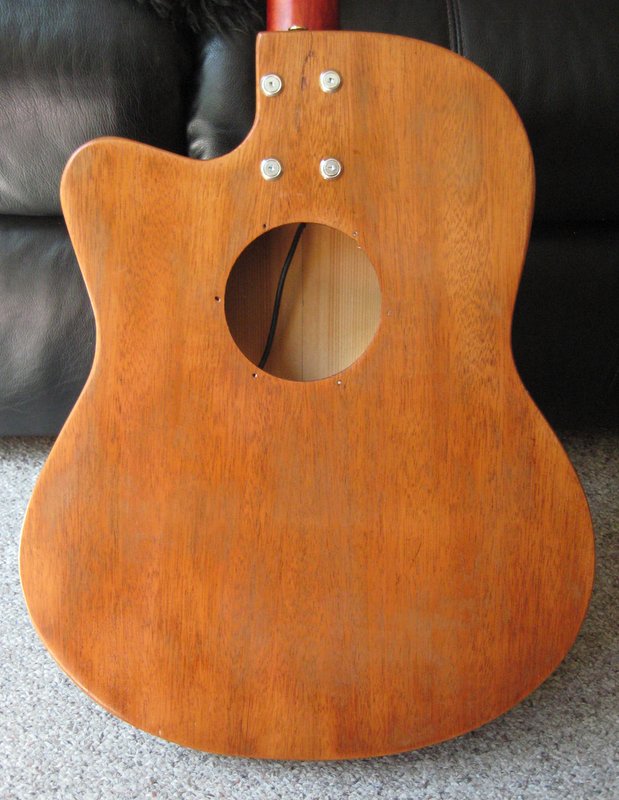
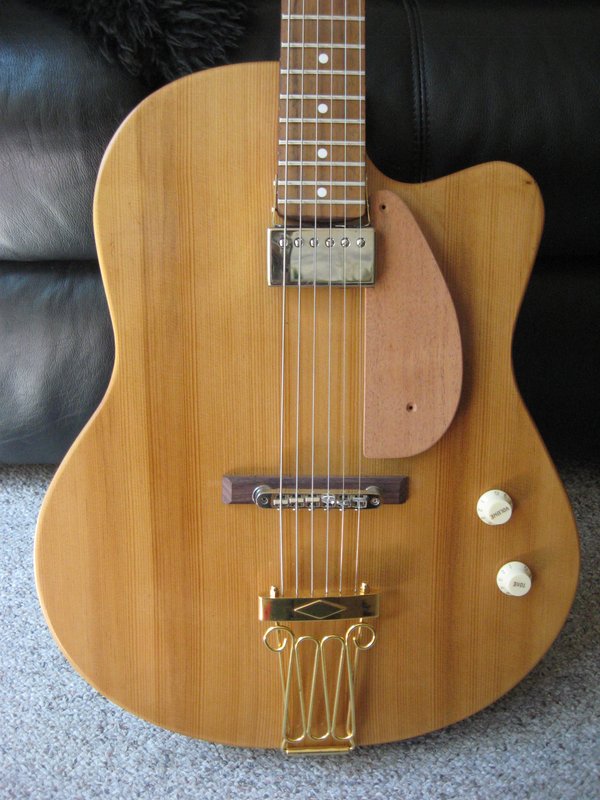
This year has been crazy, but it did allow me to make more guitars than I ever did before. Thus I built #36 one week ago, in 7 days. It began with an idea about how I could use an old pickup. This pickup is a Seymour Duncan Jazz Humbucker I bought over a decade ago and rarely used. I had it on an old beater electric but didn’t like the sound of it on that, so it ended up in my box of parts for many years.
Recently I got it out and decided to mess with it by breaking off the legs so I could stick it right onto the soundboard of my latest Corona guitars, which have a space at the end of the neck deep enough for that to work. It sounded very good, but it just didn’t quite fit, so I puzzled over what I might do with it. Then I remembered an old guitar neck I got cheap at a thrift store some time past. It was a Fender style bolt on neck a bit thicker than the depth of my Corona neck extension, so the pickup would fit there with room to spare. I just needed a way to install it, since it now had no legs.
I hit on the idea of attaching it to the end of the neck with a bracket, like the Johnny Smith pickups on various archtop guitars. I got a metal pickup cover and soldered onto that a brass bracket, then stuck the legless pickup inside the metal casing and soldered it in place. I had a suspended pickup and all I needed was a guitar body on which to install it.
A suspended humbucker
I had lots of miscellaneous wood around, including a nice torrified Englemann spruce top, narrow walnut pieces for ribs, and an old guitar back with a hole in it. All this was perfect to construct a hollow body electric guitar from, so I immediately got to work.
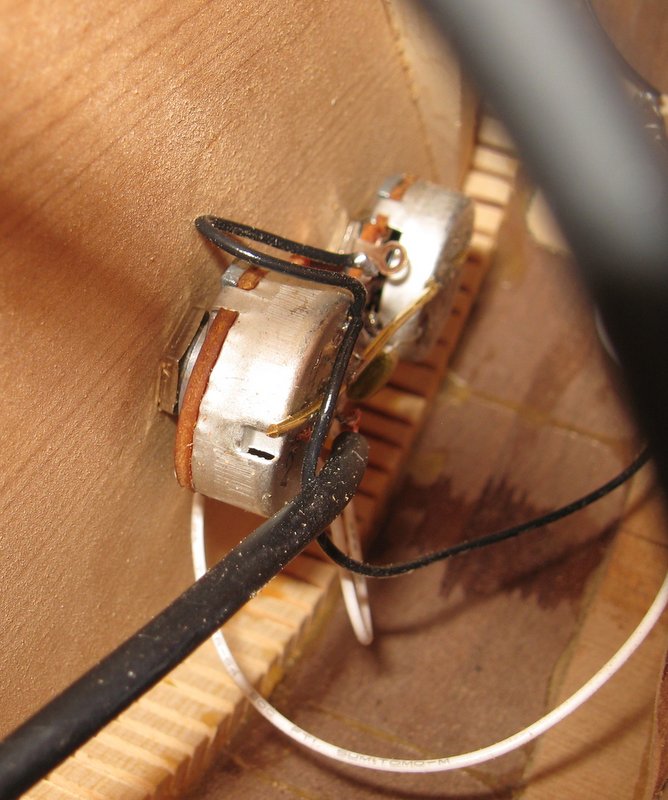
I didn’t worry about the extra thick top of over 4mm since the idea was basically an electric guitar. However, after I glued the braces on it had a very decent tap tone. I put the ribs and top together and prepped the holes for the two pots and the output jack, then attached the back. The top gave out an even better tone when the box was assembled, so I decided not to cut a sound hole or f-holes in the top until I heard how it sounded. After all, there was a decent sized hole in the back already.
Repurposed back plate and hole to provide access for controls.
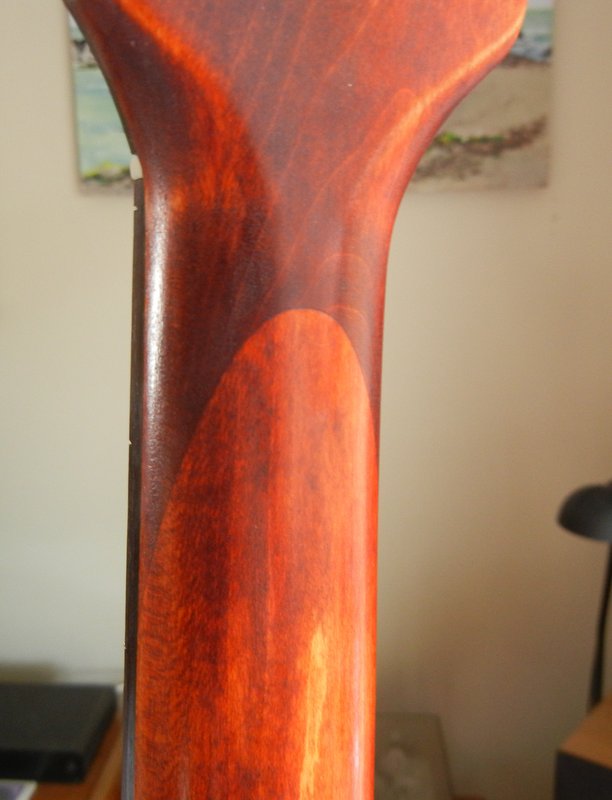
I had to modify the headstock to take 3 + 3 tuners, since that was all I had to work with and I don’t like the 6 in line ones much anyhow. I did this and installed the tuners and screws to act as posts for the strings in order to prevent the sideways pull of the strings from yanking the nut out of line. This was ugly but free and worked fine. The tuners were a nice set of Grovers acquired free from my sister. Thanks Val!
Modified headstock for 3 + 3 tuners
So, I got it all assembled and wonder of wonders, it sounds great without a hole in the top. Imagine my shock! Despite the thick soundboard and lack of hole, this thing is loud and sounds a lot like a carved archtop with the strong attack you want in jazz. The pickup is great too and deserves the reputation it has for not only jazz but most any type of electric guitar music you can name.
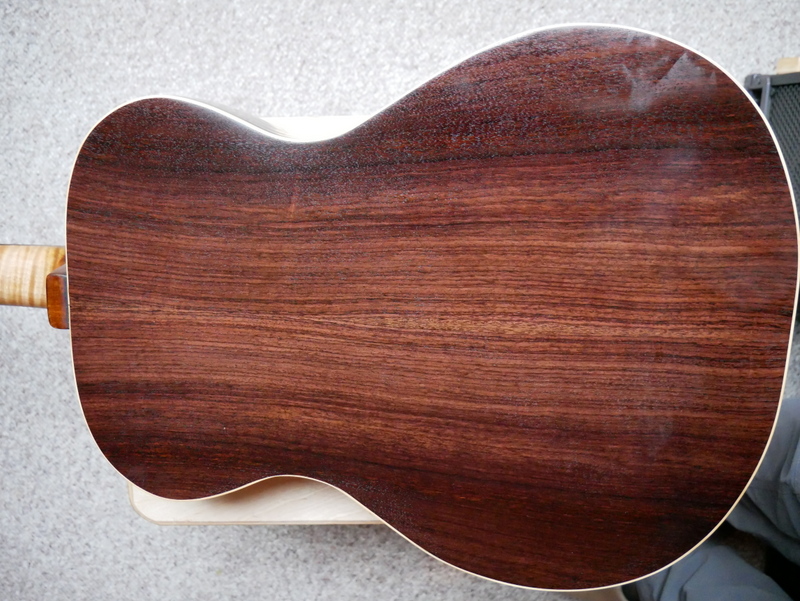
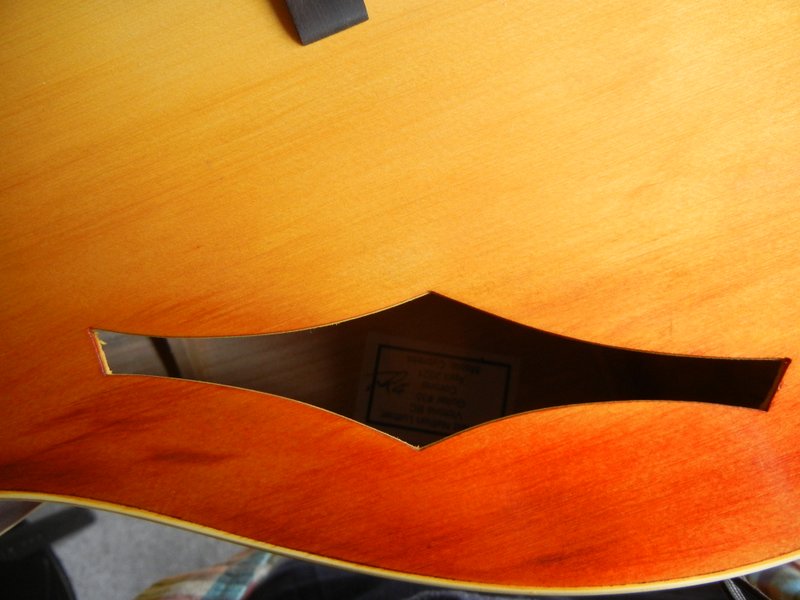
Recently finished this guitar. Maple body, cypress top. Hand rubbed French polished sunburst finish, somewhat like the bass I made before this. The yellow stain is made from turmeric in alcohol and the red brown colour is Dark Brown leather dye, which works on wood. I used that on the entire maple body and neck. This guitar is a full depth body of 4″ with x braced top like my previous Corona models. Previous models of this design were 3″ deep, so this one has a bit more low end. As part of this experiment this top has less arch, and I used cedar for the braces to see how that might effect the tone. Conclusion – it worked out very well. It’s loud and bright but more mellow than my normally arched tops. This one is perhaps the best of the bunch of Coronas, due to the balance between attack and sustain. It certainly holds its own in a jam and is not at all nasal, although real loud!
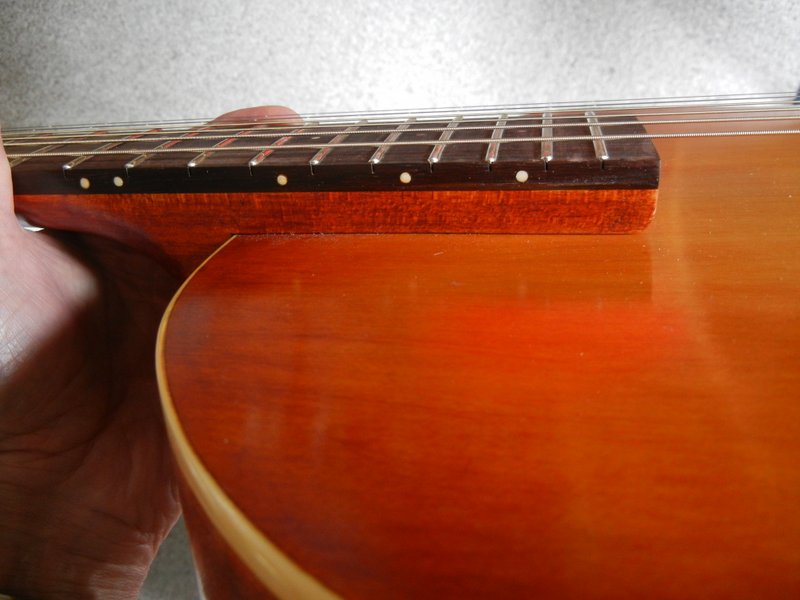
Strung it with Martin 80/20 light strings, to my ear the closest thing to Argentines at far less cost. 80/20 bronze alloy (4:1 copper to tin) is thousands of years old and the same stuff they make church bells of etc, so the magic formula hasn’t changed over time. I made the head-stock joint lower down on the neck this time, which I think I now prefer the look of. With a 2 way truss rod I can dial the neck from flat to whatever relief I want. The neck is on the fat side, a bit larger than usual but I like the feel of that too, as it is substantial and will be very stable, especially being hard maple. The fingerboard is extra thick as well, which contributes to the overall stability. With zero tension on the truss rod, the neck has a bit of relief. I dropped that to a tiny bit for now, but it is very easy to tweak it either way.
The bridge is Japanese, and rosewood this time as opposed to ebony on my previous ones. Rosewood is better to work with than ebony, which is brittle as heck. I had to cut it down a bit since they come too tall for this design.
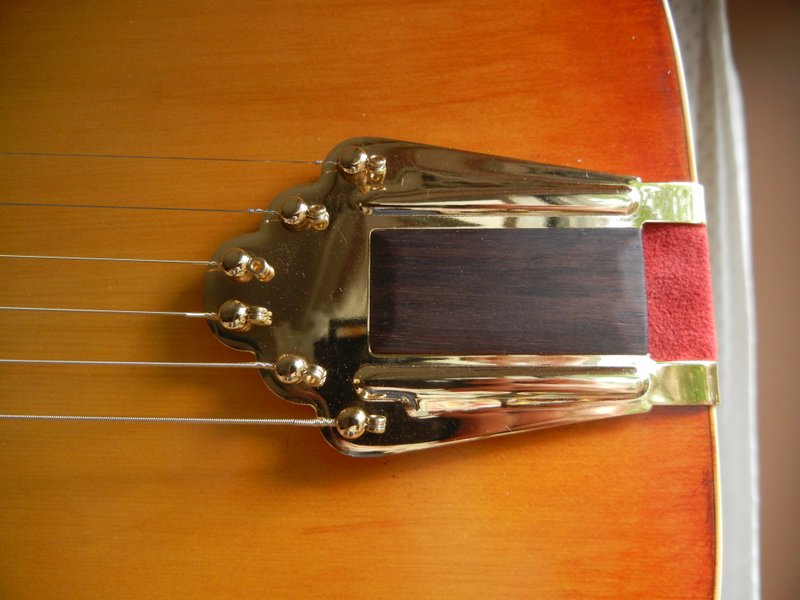
Tailpiece is gold plated steel. I made the wood insert for it as they come without one. Hard to argue with the low price of stuff from China, and it’s really not bad looking. The brass ones cost almost 10 times the price !
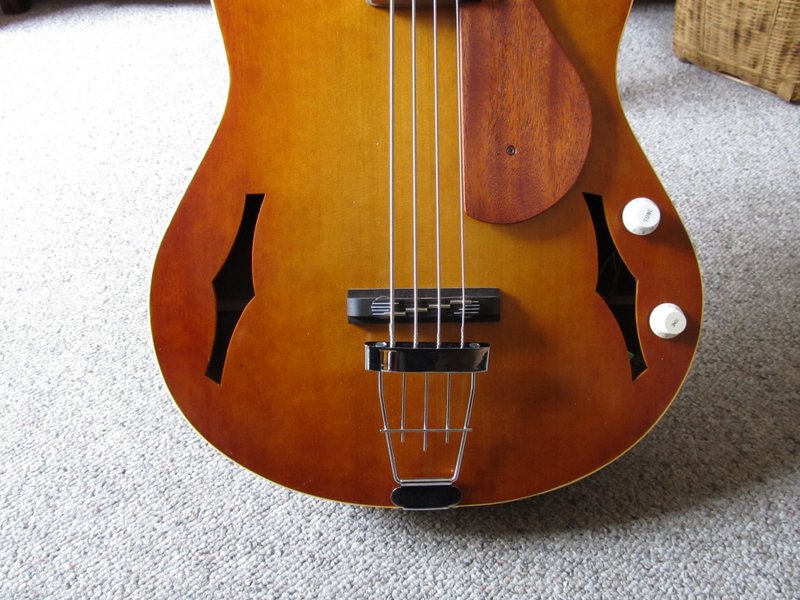
I just completed my 34th guitar, this one being a bass. I used the same body shape as my recent Corona style, which was convenient in several ways: I had the mold for it, and it reminded me of the Hofner Club Bass. I own a Jazz Bass solid body which is heavy and has a 34″ scale. I wanted a short scale instrument that would be easier to play and also lighter, so I decided to use the Hofner look for inspiration. I ordered a Chinese made copy of the tailpiece and bridge, and set to work designing the instrument. If you set out to build a guitar, or any instrument, you better have an accurate plan, unless you have built whatever you plan to make many times. I can build a guitar almost from memory now, but the bass has significant differences. So I designed it with my old CAD program (Vectorworks 10) which although now an antique of software, still does what I need it to do. I have designed all sorts of buildings and other things with this, and I am very comfortable with how it works.
Since the bass has long strings, which are also very thick, the forces involved are much greater than on a typical six string. I did some research and figured out what the best strings weights would be (50-105) for a short scale bass. The shorter scale also requires heavier strings for the same frequencies, or else the strings will flop around more than they should. Think of down tuning a guitar and how sloppy the strings feel. To use regular strings made for 34″ necks on a 30″ neck would be like detuning a regular bass. I tried this, and it was bad! Using information published by D’Addario I was able to build a table of string weights, unit mass, frequency, scale length and break angle. This gave me the string tensions and the pressure on the bridge. From this I basically guessed how heavy to make the braces, hoping that my intuitive feel for the strength of wood would suffice. To be safe I erred on the side of overbuilding, so the whole thing would not collapse. Since it was to be an acoustic bass however, I didn’t go too far in that direction, or it would have been acoustically dead.
In any case I built it as per plan and of course when it was done I discovered that my instrument was not exactly what I had planned for. Tiny angular rotations, like the neck angle, make large differences at the bridge. I had planned for a bridge of a certain height, which would mean a certain break angle of the strings. That determines the down force on the top, and the higher the bridge is, the greater the angle and down force.
My bridge height was higher than expected, meaning my bridge was now too short! I had to add a spacer underneath it to bring it to the correct height. This was not a problem except that I realized that this was going to increase the force on the top by about 10 lbs. I thought about using regular strings to reduce this, but decided that was not going to work, so I went ahead and strung it with the proper strings and hoped that my extra heavy braces would hold up. After 24 hours they seem to be fine. My sense is that the bracing was the right size after all, and like most well engineered things, had a decent margin of safety. Time will tell however, but so far it sounds great and is performing as well as hoped for.
In keeping with my desire to make my instruments as unique as I can, I made my own pickup using my home made pickup winding machine – an old sewing machine. I built the pickup from a maple core and walnut plates, with 4 neodymium magnets and many thousands of winds of 42 gauge magnet wire. The DC resistance is 10K, for those who know about this. That’s a lot of wire, but it makes for a strong signal and in this case it does not hum at all, unless I get close to a fluorescent light that is, like the one on my workbench. That induces a loud 60 cycle hum, but otherwise the single coil is fine.
I used Gotoh bass tuning heads rather than the silly little bass tuners Hofners have. For a Hofner you must buy special short scale strings with reduced end wraps in order to fit into the tiny tuners. This looks good and is lighter weight, but it restricts the sort of strings you can usually find in the music stores. These tuners allow me to use all off the shelf strings. I put Ernie Ball Slinkys on it, which are very good and as cheap a string as you will find. Maybe one day I’ll try flat wounds, but they don’t offer much except for lower noise from the friction of your fingers. I have tried them on my guitars and I always go back to round wounds, because I like that friction under my fingers. It all depends on preferences of course.
So far I resisted getting a bass amp, because in the house all I need is a low power amp and my Roland Cube Monitor can handle bass very well at low volume. For some reason bass amps are much cheaper than comparable guitar amps, but I have no idea why that is. A bass amp will work just fine with a guitar, but most guitar amps are not suitable for bass. So why do they cost more? Something about this tells me we are getting hosed!
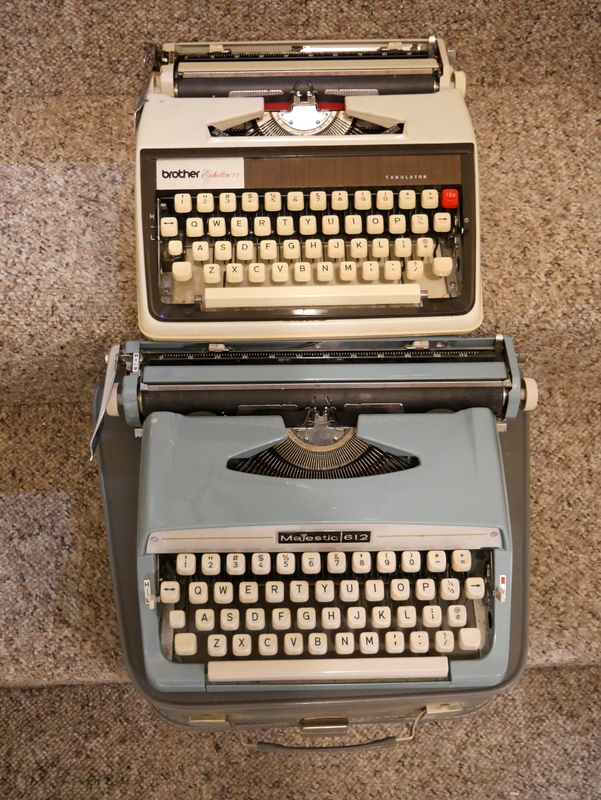
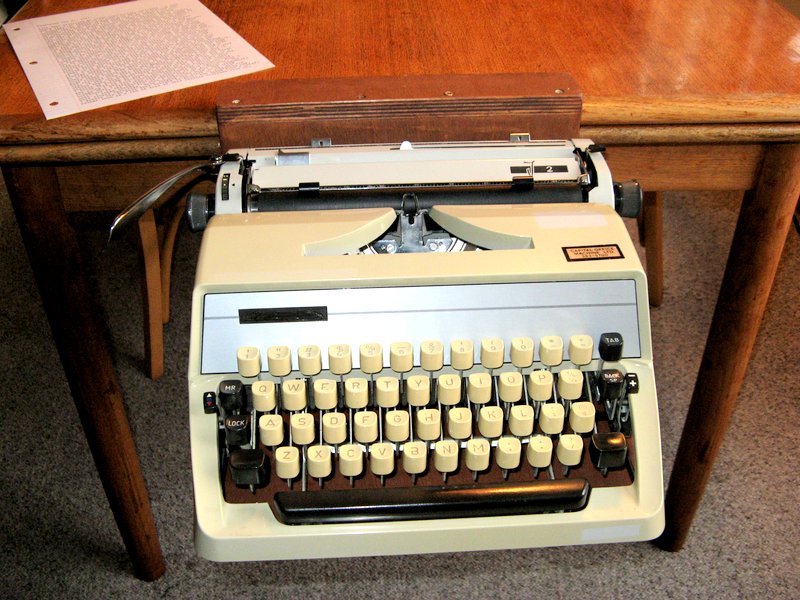
I’ve just collected my 199th typewriter yesterday – a 1974 Adler J2. I am typing on it here, to give it a test and see how I like it. Despite how good many of my typewriters are, I generally go back to the same old ones after a while, because they seem to suit me best. This has a delightful typeface however, which is a bonus. This machine has a plastic shroud, which makes it somewhat less desirable. Metal seems to be preferable for some reason, probably because I associate it with my childhood, an era for which nostalgia rules my heart. The idea of collecting typewriters is wrapped in nostalgia, because of the fact that they are now a thing of the past, and were mostly all made of metal. Only the later models had plastic shells, and though many of those are great, I and others, seem to have this preference for metal. It is illogical, but so is collecting things, unless done for profit, and even then there is not much profit in this when you consider all the time and effort spent to find a typewriter, clean it up, and fix whatever may be wrong with it. Often there are plenty of problems, and the hours spent do not pay well for the cost or price received when selling. But we persist, for the joy of finding typewriters, like birdwatchers scouring the bushes for rare birds, we scour the thrift shops in search of the new and unusual models, yet still glad to find some old favourite thing, even as we decline to buy it, unless it is such a bargain…
I wonder if typewriters were all $5 each, and there were half a dozen in every thrift shop, would anyone bother to collect them? I think not. We tend to value things that are rare and or expensive. If every typewriter was $5, which one would I buy to use? Not some rare old thing, unless it worked so well that I preferred using it over a better made model. When one removes price and rarity from the equation, then we find an entirely different set of values. I think of this as something like a blind test. I find this to be true for guitars, especially.
People will pay thousands of dollars for a guitar that has some label on it that they imagine confers a great value to it, even if in a blind test there is no difference between that and a similar guitar that is practically free by comparison. If I were to offer someone any typewriter in the world, and they had no idea what any of them were worth on the market, I bet they would chose simply by how the machine felt, how good the typed page looked, and last, what the machine looked like. But if I had informed them that the Hermes 3000 was worth ten times the cost of the one they selected, I also wager they might well change their mind fast! This happens to me, I should admit, despite my trying to judge things solely on logical grounds.
I think this is a factor of knowledge versus ignorance. When I was young I had less knowledge, and hence more ignorance. The things that I liked then were selected on my youthful judgment, unclouded by the opinions of others and or what the thing cost. I liked things for what I perceived them to be, not for what others perceived. When judging the worth or something now, I always try to keep that thought in mind, and think like a child, rather than as a fan of this or that because everyone else is.
Two months, no gigs. For a musician this pandemic has put a halt to that, among everything else. But, we came up with a plan this week – a concert on the front lawn, maintaining 2 metres between players. I debuted the Corona Gold guitar, which performed flawlessly. I however performed less flawlessly, and more so as the temperature continued to drop and the wind picked up. By 8 PM we were done, after 90 minutes straight out fun.
my band – bassist Larry is behind the tree
the sign says it all
Meanwhile, life in isolation goes on. Meetings are held via computer. Days are spent alone, mostly, making something, or lately – painting again. I made a second guitar following the pattern of the Corona Gold, but this one strictly acoustic. I switched the top bracing from parallel to X, and made the body a little deeper than the previous one. Also employed the X brace on the back, and the same projected neck design. Having a tall bridge allows using a nifty adjustable bridge too, which makes action adjustments dead simple. Body and neck are maple, with spruce top.
Corona Gold II – the acoustic version – Engleman Spruce top
back plate – arched X braced
detail of projected fingerboard
detail of neck heel
Again I finished this using wiped on polyurethane varnish mostly, with a few coats of french polish shellac on the top to make it glossy.
When the guitar was done, I decided it was time to get out the paint again, after a year. My first project was a kid sized card table, which became the canvas for duck. This is for the amusement of my 3 grandsons.
duck on a small card table
Two of them saw it, and were mostly impressed with the little pictures of trucks I painted around the edges. So much for the duck!
Next up was a scene from the Presidential Range of the White Mountains of New Hampshire. Once upon a time I spent many vacations hiking along those ridges, and several times staying in the huts. Lake of the Clouds hut is the largest of them all, and commands quite a view from its perch on the shoulder of Mt. Washington.
lake of the clouds hut
Sticking with the wilderness theme, I rendered my vision of a scene along the Cold River in the Adirondacks of New York (corrected from previous label of Raquette River, which was somewhere else). This was from a slide (Kodachrome even) I took while hiking the Northville-Placid Trail in 1979. May it remain ever wild and remote.
I’ve also been working on another picture book for kids, called Ciel The Blue Horse, and intend to publish it any day now.
Ciel frees Aaron the snail from the bucket in which he was captured.