
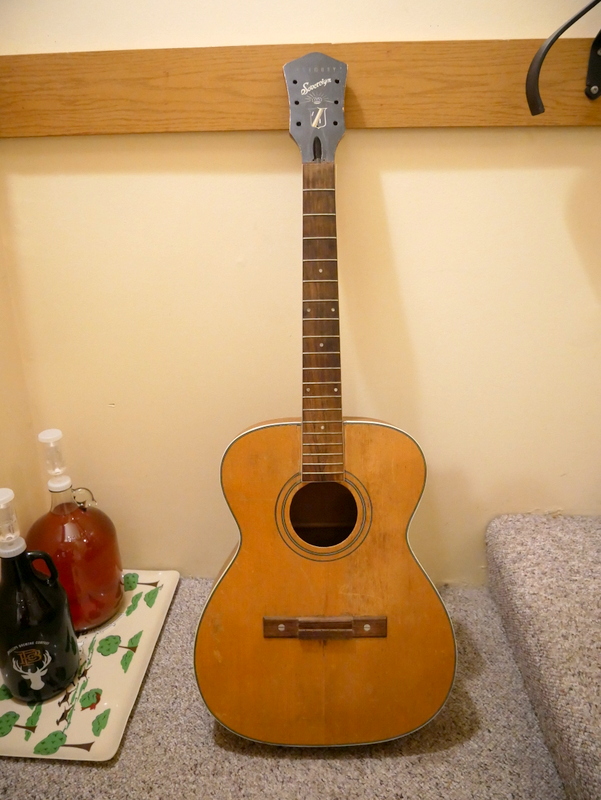

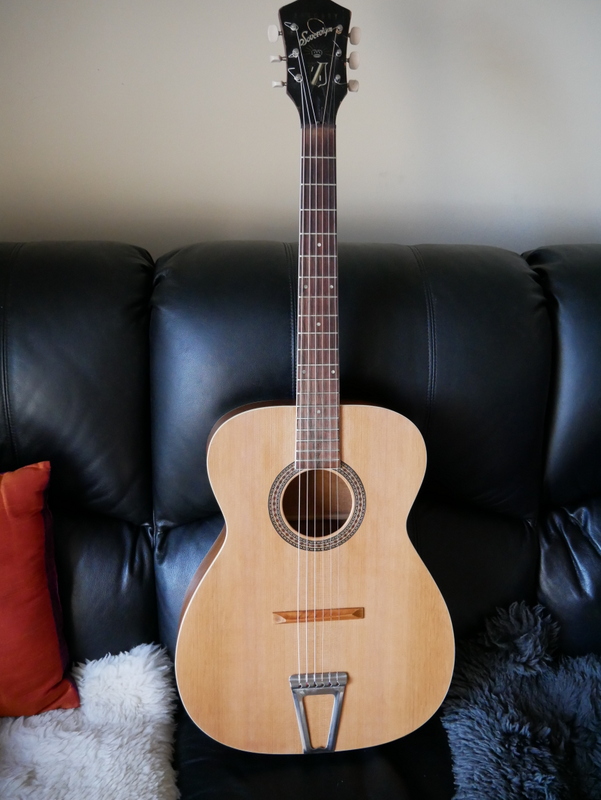
A couple of weeks ago I found this old 1960’s era Harmony Sovereign guitar for sale at the Sally Ann, cheap! The nut and tuners were gone and the top was damaged, cracked and warped. The bridge was loose and had been bolted into place. But otherwise the rest of it was in reasonable shape.
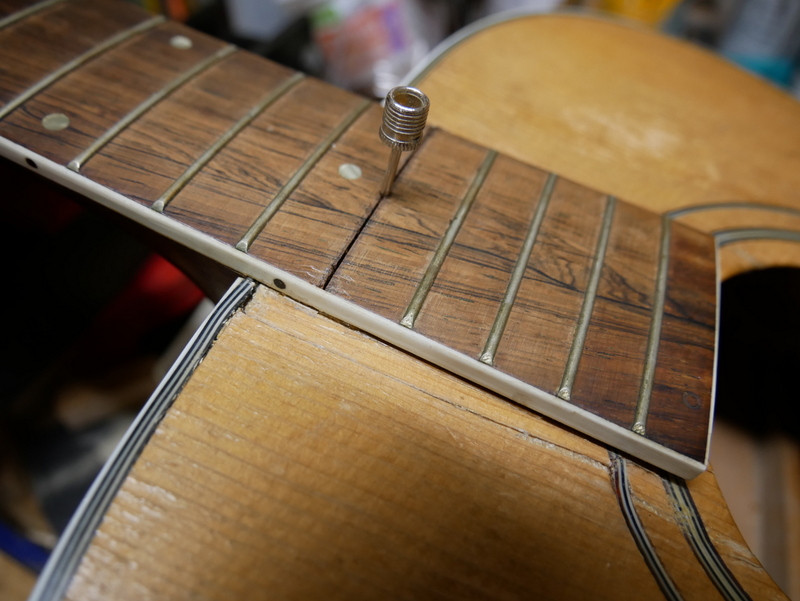


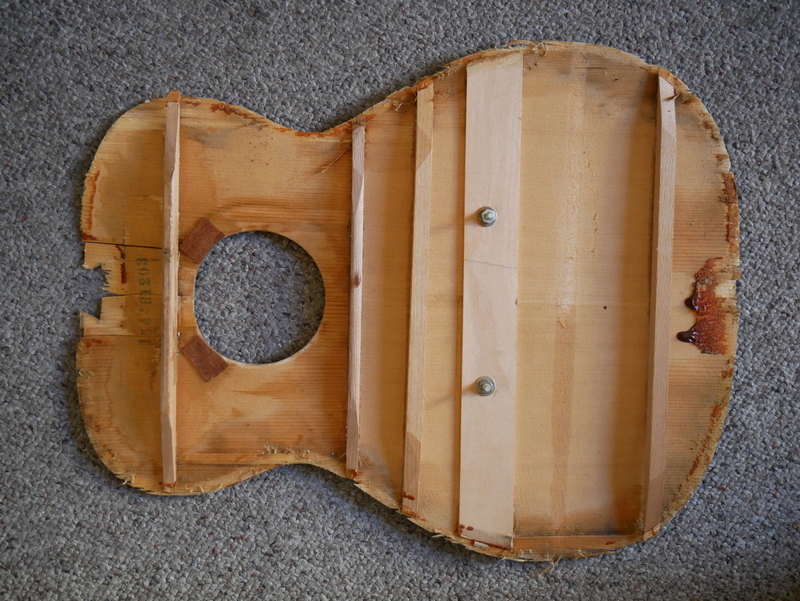
I removed the neck using steam and a special jig. These old Harmony guitars were glued with hide glue, a fortunate thing since that glue dissolves with heat and steam, enabling disassembly. The top was so damaged that I removed it, but upon inspection it was not worth repairing, so I made a new top. They built these tops with so called “ladder bracing”, no doubt to save cost, but they all fail in time because that is a bad design and cannot adequately resist the string tension over many years. To make things worse, ladder bracing may please some ears but it is almost never used anymore because it produces inferior tone in the main opinion. Some folks like it, but I am not a fan. No quality guitars are ever built with ladder bracing these days (that I know of).

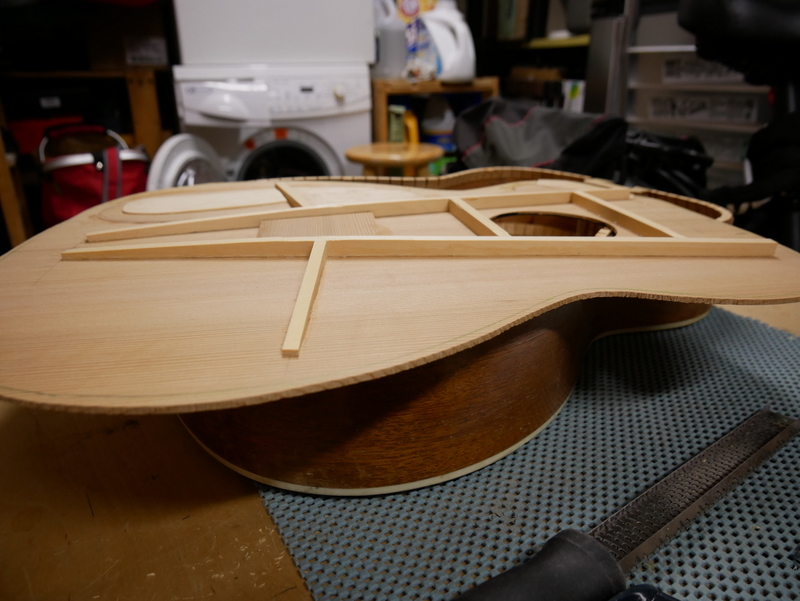
For the new bracing I went with the V brace design that I’ve used for the last 4 guitars I made. This is a proven design that has lots of advantages over ladder bracing and the common x bracing. For one thing it is extremely simple. It puts the main axis of strength in the same direction as the main deforming forces, which means it is more efficient regarding strength to mass, thus enabling less mass in the bracing. Less mass equals more efficient movement of the soundboard, and more sound, especially in the lower register. The low register is where steel string guitars tend to have problems, because many builders over brace them to ensure that the tops don’t warp under tension, which of course limits the low frequencies that are so desirable. It is not hard to get high frequencies out of a steel string guitar, but good bass is another thing. I like v braces for this reason. However, they are so darned effective that you can easily over design them. Therefore I took the two main braces down to a mere 10mm this time, because on previous guitars of similar size I had to go in after they were built and plane the braces down to around that height in order to loosen up the tops and get the bass going.


After a lot of testing of neck angle and what not I assembled the top, put on binding, and glued the neck back in place. Everything was perfect, but then I had second thoughts about the bridge. My design called for a typical glued on bridge with pins, which I was sure would work well enough. However, while waiting for the new bridge to arrive in the mail, I thought I would test the guitar with a floating bridge and a tailpiece. I had a suitable tailpiece that resembled those from some old Harmony and Stella guitars, and I made a bridge from a piece of maple. After I got it strung up I was pleasantly surprised to find that it sounded great, and very sweet toned with lots of bass. In short, perfectly acceptable for my purpose. So I left it that way. There is very little pressure on the bridge, and yet the guitar has plenty of volume and punch. So much for all those guitar experts who go on and on about break angles. There is no end of pseudo science among guitar nerds and luthiers; so beware of bullsh*t and trust your own ears!



 nathanguitars